
Las Casas de la Selva in Puerto Rico
Las Casas de la Selva: Four Decades of Rainforest Restoration, Sustainable Forestry, and Ecological Innovation
In 1983, the Institute of Ecotechnics launched its final major field project, Las Casas de la Selva, in the mountains of southeastern Puerto Rico near the municipality of Patillas. What began as an ambitious experiment in sustainable rainforest management has evolved into one of the Caribbean’s longest-running demonstrations of ecological restoration, sustainable forestry, conservation research, and environmental education.
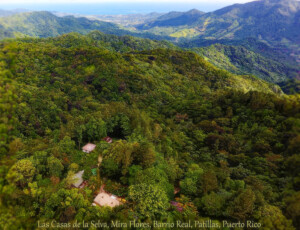
The origins of the project can be traced to a broader question that emerged from the Institute’s earlier work around the world: how can people meet their material needs while maintaining healthy ecosystems? Members of the Institute of Ecotechnics had spent years working in diverse environments, including deserts, oceans, urban systems, and agricultural landscapes, and were the original pioneers of Biosphere 2. In an expedition aboard the Research Vessel Heraclitus through the Amazon, the crew witnessed firsthand the rapid destruction of tropical forests and the loss of biological diversity occurring throughout the world.
Inspired in part by conversations with renowned ethnobotanist Richard Evans Schultes, often regarded as one of the pioneers of modern rainforest conservation, Institute members became interested in developing practical alternatives to tropical deforestation. Rather than viewing forests solely as resources to be extracted or areas to be locked away from human use, they sought to demonstrate a model in which ecological integrity and economic productivity could coexist.
To pursue this vision, the Institute acquired approximately 400 hectares of land in Puerto Rico’s Sierra de Cayey mountain range adjacent to what is now the Carite State Forest. The property had a long history of agricultural use, including coffee cultivation, grazing, and small-scale farming. Much of the land had been cleared decades earlier and was characterized by secondary forest, erosion, and degraded soils. Many considered the area to have little economic value.
Yet the project’s founders saw potential.
Among those instrumental in establishing Las Casas de la Selva were Institute of Ecotechnics co-founders John P. Allen, John Druitt, and Harry Scott, whose vision was supported by leading tropical forestry experts. Two particularly important advisors were Frank H. Wadsworth and Peter L. Weaver of the International Institute of Tropical Forestry. Their guidance helped shape the scientific and forestry foundations of the project.
Beginning in the mid-1980s, the team embarked on an ambitious enrichment planting program. Rather than clear existing forest to establish plantations, they adopted a method known as line planting. Narrow corridors were cut through the secondary forest canopy and planted with high-value tropical hardwood species. Over several years, approximately 40,000 seedlings were established across roughly 300 acres of rainforest.By retaining most of the existing forest structure, the project protected soils, maintained wildlife habitat, reduced erosion, and preserved watershed functions while encouraging the growth of valuable timber species beneath the canopy. The method sought to work with the ecological processes already underway rather than replace them.
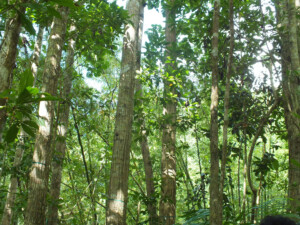
Line-planted Blue mahoe/ Majo Azul (Hibiscus elatus)
As the trees matured, Las Casas became an important long-term experiment in tropical forest management. Researchers monitored growth rates, survival, regeneration, biodiversity, and ecosystem health. The project demonstrated that carefully managed enrichment forestry could produce high-quality tropical hardwoods while maintaining many of the ecological characteristics of a functioning rainforest. Students, researchers, volunteers, and interns from around the world visited the project to study tropical ecology, forestry, watershed management, conservation biology, and restoration techniques. Long-term collaborations with universities, conservation organizations, and educational institutions expanded the scope of research taking place within the forest.
One of the most influential partnerships was with Earthwatch, whose citizen-science expeditions brought hundreds of volunteers to Puerto Rico over more than a decade. Participants assisted with ecological surveys, forest monitoring, biodiversity assessments, and research projects, contributing thousands of hours of fieldwork while gaining direct experience in tropical conservation.
As the forest matured, the project entered a new phase focused on demonstrating sustainable timber production. Individual trees were selectively harvested according to management plans designed to minimize disturbance to surrounding vegetation. Harvesting was accompanied by ongoing regeneration, monitoring, and replanting efforts. This work helped demonstrate that tropical hardwoods could be produced through long-term stewardship rather than large-scale forest conversion.
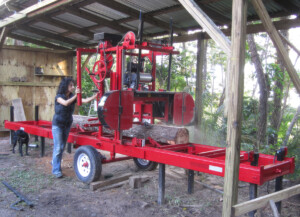 Cooks Sawmill
Over the decades, Las Casas has weathered numerous natural disturbances that have tested both the forest and the people working within it. Hurricane Hugo, 1989, Hurricane Georges in 1998, Hurricane María in 2017, Hurricane Fiona in 2022, and Hurricane Ernesto in 2024 each left their mark on the landscape. Storms toppled trees, triggered landslides, altered drainage patterns, and damaged infrastructure. Yet they also provided valuable opportunities to study resilience, succession, watershed dynamics, and forest recovery.
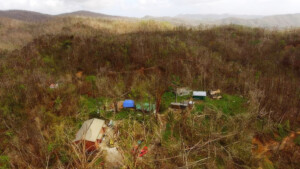 The devastation of Hurricane Maria, 20 September 2017
Today, Las Casas de la Selva encompasses far more than forestry alone. The project now integrates rainforest conservation, ecological restoration, watershed protection, climate adaptation, biodiversity research, sustainable agriculture, environmental education, and cultural initiatives. The forest provides habitat for a rich diversity of plants, fungi, birds, reptiles, amphibians, and invertebrates, including rare and threatened species found only in Puerto Rico.
The project has also become a place where science, art, and ecological practice intersect. Artists, writers, educators, and researchers regularly visit the forest, finding inspiration in its landscapes and participating in programs that explore the relationship between humans and the natural world. This interdisciplinary approach reflects the Institute of Ecotechnics’ longstanding interest in understanding the interactions between ecological systems and human culture.
Today, the work at Las Casas de la Selva continues through the Tropic Ventures Research & Education Foundation, which supports research, conservation, education, and community engagement across the property. Through volunteer programs, workshops, field courses, internships, and collaborative research initiatives, the foundation welcomes participants from Puerto Rico and around the world.
The project also maintains a close relationship with Puerto Rico Hardwoods, an enterprise dedicated to the responsible recovery, processing, and utilization of locally sourced tropical hardwoods. By promoting the use of salvaged and sustainably managed wood resources, Puerto Rico Hardwoods helps demonstrate how forest products can contribute to local economies while reducing waste and supporting conservation goals.
More than forty years after its founding, Las Casas de la Selva remains a living laboratory and a working example of long-term ecological stewardship. What was once regarded as marginal land has become a thriving forest landscape that supports biodiversity, protects watersheds, produces valuable timber, advances scientific understanding, and provides educational opportunities for future generations.
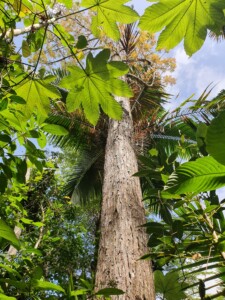 38-year-old mahogany tree (Swietenia x aubrevilleana) at Las Casas de la Selva
At a time when tropical forests worldwide continue to face mounting pressures from climate change, habitat loss, and unsustainable land use, Las Casas offers a different narrative. It demonstrates that conservation and responsible resource use are not mutually exclusive. Through patience, scientific inquiry, adaptive management, and long-term commitment, degraded lands can recover, forests can remain productive, and people can participate in the stewardship of the ecosystems upon which they depend.
More than a forestry project, Las Casas de la Selva stands as an ongoing experiment in ecological responsibility, resilience, and renewal. Its history reflects over four decades of learning from the rainforest itself and continues to provide valuable lessons for sustainable land management in Puerto Rico and beyond.