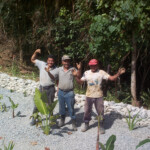
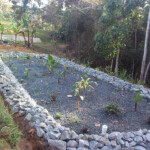
The first Wastewater Garden in Puerto Rico, 2004
Wastewater Garden at Las Casas de la Selva, Patillas
In 2004, Las Casas de la Selva became home to one of Puerto Rico’s first Wastewater Gardens® (WWG), constructed with support from the Puerto Rico Department of Natural and Environmental Resources. The project was developed as a demonstration of ecological wastewater treatment within a tropical rainforest setting, reflecting Las Casas’ commitment to integrating sustainable technologies with environmental stewardship.
Located within the mountains of southeastern Puerto Rico, Las Casas encompasses approximately 1,000 acres of forested land drained by numerous streams that flow into the Río Grande de Patillas watershed and ultimately to Lake Patillas, an important source of drinking water and irrigation for surrounding communities. Protecting water quality has therefore always been a priority. The Wastewater Garden was designed to naturally treat wastewater from the project’s main homestead while preventing contamination of nearby streams, groundwater, and downstream water supplies.
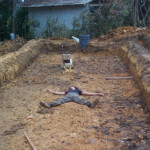
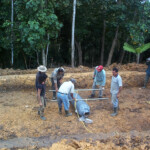
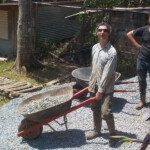
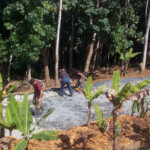
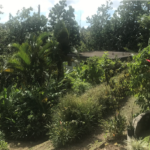
Construction presented significant challenges. The system needed to be located downslope from the homestead to serve its toilets, showers, and other facilities. Heavy rainfall and difficult terrain made it impossible to bring excavation equipment to the site. As a result, staff and volunteers excavated the treatment basin entirely by hand. Even transporting materials proved difficult; gravel for the filtration beds had to be moved up the steep hillside wheelbarrow by wheelbarrow.
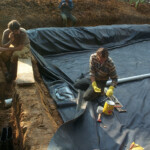
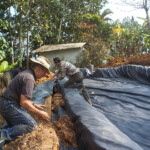
The project was developed in collaboration with the Biosphere Foundation (then operating through its Planetary Coral Reef division), with Mark Nelson serving as principal consultant. The EPDM geomembrane liner used in the system was donated by the Bridgestone Firestone Foundation.
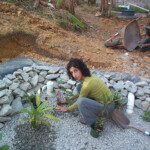
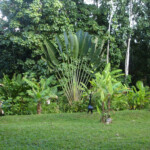
The garden was planted with a diverse mix of tropical species sourced from the property itself, local nurseries, and donations from friends of the project. Plantings included heliconias, gingers, canna lilies, oleanders, palms, bananas, and other tropical ornamentals. At its center stands a striking traveler’s palm (Ravenala madagascariensis). Treated water from the system is dispersed through subsurface irrigation, supporting additional tropical vegetation around the homestead.
Water quality testing demonstrated that the system was highly effective at reducing organic pollutants, nitrogen, phosphorus, and potential pathogens. To further protect the installation from erosion on the steep mountain slope, a barrier of deep-rooted vetiver grass was established uphill of the garden.
Over time, the Wastewater Garden matured into one of the most attractive landscape features at Las Casas, combining practical wastewater treatment with lush tropical beauty. Its resilience has also been remarkable. The system successfully withstood Hurricanes Irma and Maria in 2017 and Hurricane Fiona in 2022. Although the vegetation experienced temporary defoliation during these extreme events, the plants quickly regenerated their canopies and the system continued to function effectively.
More than two decades after its construction, the Wastewater Garden remains a working example of how nature-based infrastructure can provide reliable, low-energy wastewater treatment in remote tropical environments. Its long-term performance demonstrates the value of ecological engineering approaches that remain operational even when conventional treatment systems, dependent on pumps, aerators, and electrical infrastructure, are vulnerable to disruption from severe storms and other climate-related disasters.
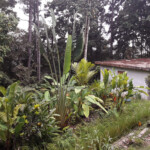
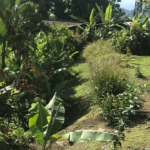
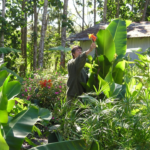
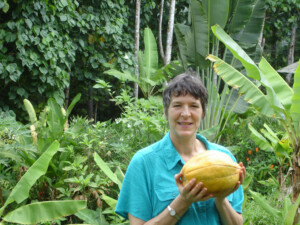
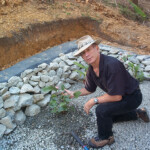
The team that gathered in 2004 to complete this project in 15 days were: Dr. Mark Nelson, Chairman of the Institute of Ecotechnics, Mark ‘Laser’ Van Thillo, Abigail Alling, Gessie Houghton, Robert Townsend, Gregg Dugan, Chris ‘Dolphin’ Cook, Gilberto ‘Tingo’, Carmelo Torre, Javier Rojas, Sally Silverstone, and 3t Vakil.
Big Thanks to: Zabel Corporation, and Brian Borders for parts and filters for the Wastewater Garden. Firestone Corporation, and Marco Seiber for the donation of the liner for the Wastewater Garden and with all the help in getting it to us on time.
The Making of the Wastewater Garden