
Wastewater Gardens International in Algeria
Wastewater Gardens International pioneered the first Wastewater Garden in Algeria, for a restored historic caravanserai city in Temacine. At the suggestion of well-known Algerian artist, Rachid Koraichi, the system took the shape of a crescent moon.
Wastewater Gardens International in cooperation with the Institute of Ecotechnics pioneered by bringing the first Wastewater Garden to Algeria, for a restored historic caravanserai city in Temacine. At the suggestion of well-known Algerian artist, Rachid Koraichi, the system took the shape of a crescent moon, an important symbol culturally.
The Institute of Ecotechnics had been invited in 2006 to submit a tender to the Department of Sanitation and Environmental Protection (Ministère des Ressources en Eau / Direction de l’Assainissement et de la Protection de l’Environnement – MRE/DAPE), with co-funding from the municipality of Temacine and the Belgian Technical Cooperation – ADB/CTB, to develop new integrated water resources management practices; included in the delivery of the constructed wetland treatment plant was a 3-day workshop for 17 engineers, officials, architects, agronomists, students, including training manuals.
In 2007, a pilot Wastewater Gardens system was installed to begin sewage treatment of a group of houses and a mosque of Temacine’s Old Ksar, a historic site that was for many centuries a stop on the road to Mecca for North-West African habitants and which is currently under renovation by UNESCO. This project was conducted at the initiative of Shams Association in association with the Zaouia Tidjania and the Algerian Ministry of Water Resources, with financial assistance of Belgian foreign aid. Implementation was led by Florence Cattin, director of international development Wastewater Gardens International and Dr. Mark Nelson. The system covers 650 m2 and treats the sewage of 150 people. Temacine is a center for the progressive Tedjani Sufi order, and Sheikh Med Laïd Tidjani was very supportive of bringing the technology to the region. Funding for the project was through Belgian Foreign aid and the Algerian Ministries of Water and the Environment. During the construction of the Wastewater Garden, Nelson and Cattin led a workshop for Algerian health officials and engineers explaining the principles behind the design, implementation and maintenance of constructed wetlands.
Using the system as a show-case system for the region, the design team called on Portugal-based landscape designer and agronomist Maurice Levy of Earth & Water and established an informal partnership with the local Touggourt branch of INRAA, Algeria’s national agronomic research center. A total of 941 plants from 23 species, including 14 test species were planted in the constructed wetland of which at least 400 were deep rooted.
Water quality test results have consistently reached Algerian and international standards of water purification through almost 20 years of operation.
The system was very successful and the Algerian government moved to implement more than a dozen constructed wetlands for towns throughout the country inspired by this initial demonstration project in Temacine.
The system has been studied in detail and more information is available through the following books, book chapters and research papers:
Nelson, M., Cattin, F., Tocchetto, D., & Hafouda, L. (2022). Wastewater Gardens Systems in Yucatan, Mexico; Northwest Australia; Northern Algeria and Southern Iraq. In Constructed Wetlands for Wastewater Treatment in Hot and Arid Climates (pp. 357-378). Springer, Cham. https://doi.org/10.1007/978-3-031-03600-2_20.
Nelson, M (2014) The Wastewater Gardener: Preserving the Planet One Flush at a Time. Synergetic Press, Santa Fe, NM.
Nelson M, Cattin F, Hafouda L, Rajendran M (2008) Value-adding through creation of high diversity gardens and ecoscapes in subsurface flow constructed wetlands: Case studies in Algeria and Australia of Wastewater Gardens systems, IIth International Conference on Wetland Systems for Water Pollution Control, Indore, India, International Water Association (IWA), Vikram University IEMPS, ICWST, November 2008
Merah A et al (2019) Processus de valorisation du Ksar de Temacine, quels dispositifs et stratégie de communication? 2019 ICOMOS Advisory Committee Scientific Symposium, Marrakesh, Morocco.
Khemici Y, (2014) Etude de la qualité physico-chimique et bactériologique d’une eau usée épurée par un lit de plantes; thesis, Master in Technical Science, Hydraulics, with a specialty in Wastewater Treatment, University Kasdi Merbah Ouargla, Algeria
Bachi OE, Halilat MT, Bissati S (2015) Sewage in Algerian Oasis: Comparison of the Purifying Efficiency of two Processes (WWTP and WWTAS). Energy Procedia 74 (752-759), August 2015
Hafouda L, Hadad M, Arif Y, Djafri K, Balleche O, Talab B, Ebba MS, Nelson M, Cattin F, (2008) L’épuration des eaux usées domestiques par les plantes; une alternative à encourager pour une préservation durable de l’environnement en zones arides : cas de la station pilote du vieux Ksar de Témacine, Touggourt, Algérie. International symposium on Dryland Cultivation, Optimization of Agricultural Production and Sustainable Development, Centre for Scientific and Technical Research on Arid Regions (CRSTRA), Biskra, 13 and 14 December 2008
Hammadi B, Bebba AA, Hacini Z, Zeghdi S (2013) Gardens Planted with Macrophytes Filters, Purification Performance in an Arid Climate – Pilot Station of Témacine, Ouargla (Algeria). International Letters of Chemistry, Physics and Astronomy 13 (259-268)
Tidjani H (2019) Etude de l’Efficacité et la Valeur Ajoutée d’un Système de Phytoepuration Pilote en Algérie : La Station Pilote Vieux Ksar Temacine; thesis, Master in Agronomical Sciences with a specialty in vegetation production, University, El Oued, Algeria
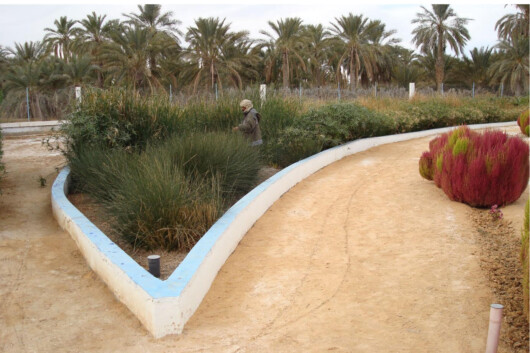
Algerian WWG a few years after planting
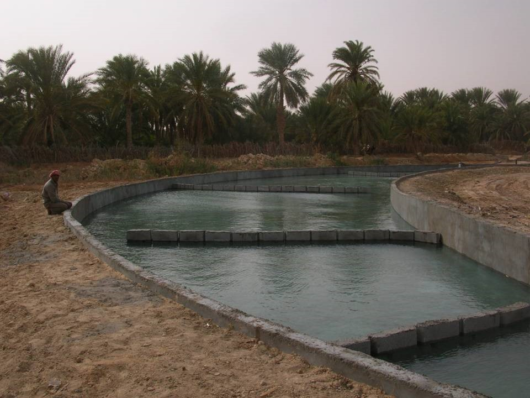
Temacine, Algeria. System is filled with water to test for leakage before gravel and plants are added (photo: Florence Cattin)
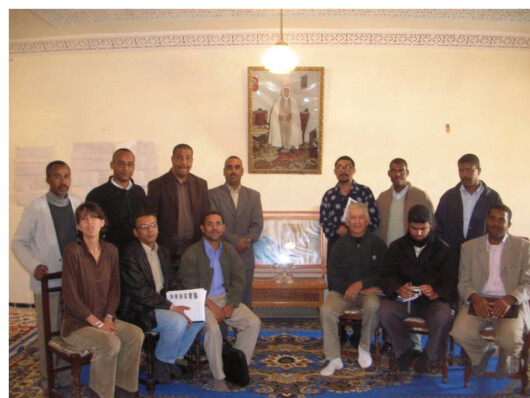
Workshop in Wastewater Garden Technology andapplication, temacine Algeria
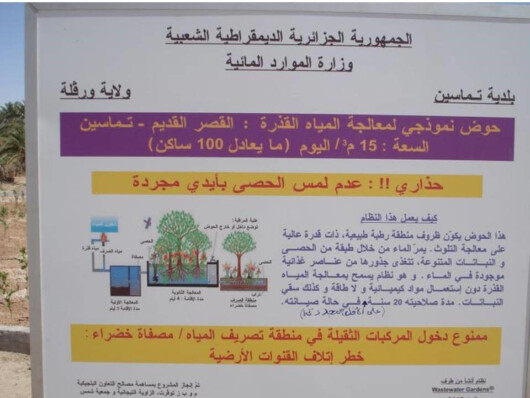
Sign in Arabic Explaining how the WWG works (photo: Mark Nelson)