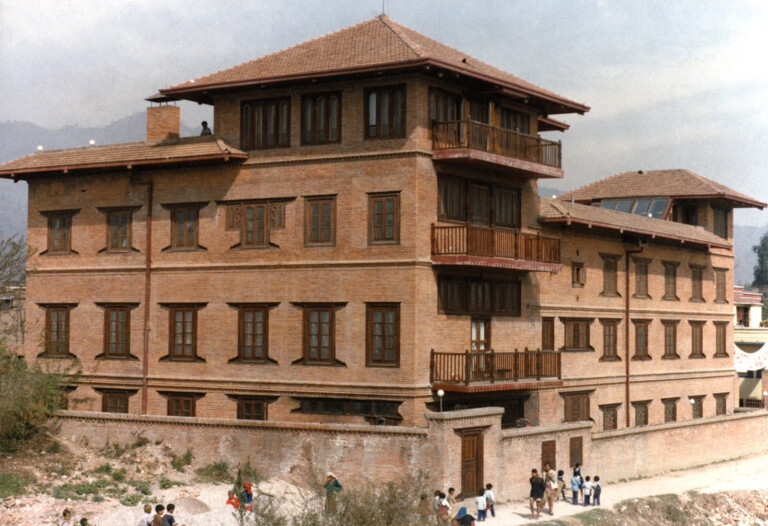
Hotel Vajra in Kathmandu, Nepal
The Vajra Hotel in Kathmandu was one of the earliest projects developed with the consultation and participation of members of the Institute of Ecotechnics. Built in 1981, the hotel was designed by ecological and cultural entrepreneur John Allen, working with Margaret Augustine, project design manager, and chief architect Phil Hawes. Drawing inspiration from Nepal’s architectural heritage, the design combined traditional Newari craftsmanship, pagoda forms, and sacred architectural principles with modern earthquake-resistant engineering techniques. The building’s resilience was demonstrated when it survived the devastating 7.8 magnitude earthquake that struck Nepal in 2015.
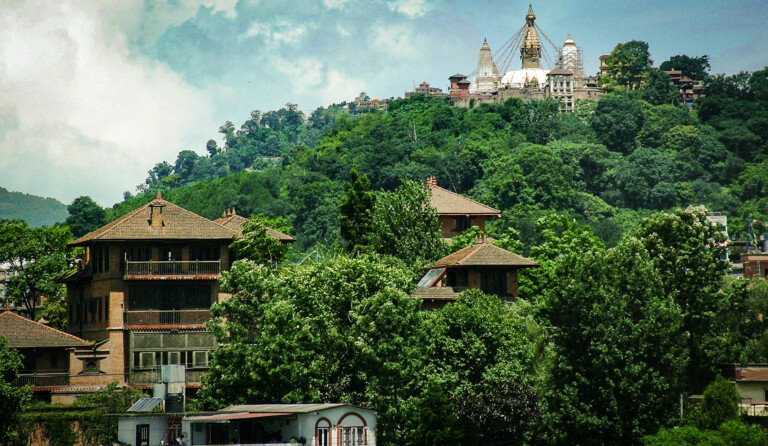
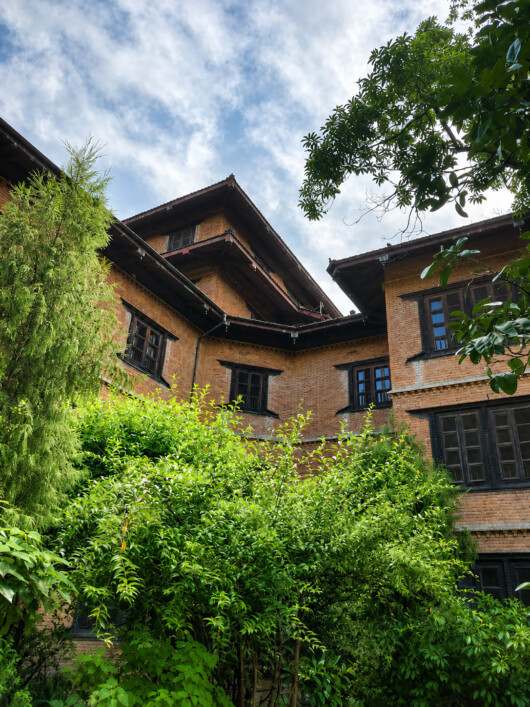
Located beside the historic Bijeswori Temple complex and within walking distance of Swayambhunath (“the Self-Realized One”), the Vajra became both a cultural landmark and a waypoint for pilgrims, travelers, and scholars visiting Kathmandu. The hotel’s architecture is distinguished by its hand-carved windows, doors, balconies, and woodwork created by master Newari artisans. Its rooftop pagoda, one of the hotel’s most celebrated spaces, features traditional Tibetan murals painted by renowned artist Rinchen Norbu and his students, creating a remarkable synthesis of Nepalese and Tibetan artistic traditions.
Vajra succeeded in realizing a central vision: bringing together representatives of East and West culturally and North and South politically in a single place of exchange and encounter. Together with the voyages of the Heraclitus, the hotel provided the Institute of Ecotechnics and its associates with a unique gateway into both the ethnosphere and the biosphere.
Explorers, anthropologists, ecologists, dancers, conservation organizations, development groups, artists, scholars, and travelers gathered at Vajra for meetings, conversations, performances, collaborations, and conferences. The hotel became known as a place where scientists, entrepreneurs, spiritual teachers, artists, and cultural practitioners could meet across disciplines and traditions. Rinpoches, swamis, depth psychologists, Asian art scholars, Baul singers, European yogis, and philosophical teachers all found a home beneath the painted ceilings of the rooftop pagoda.
The Vajra also became a venue for artistic and theatrical collaborations. Performers from Tibetan, Nepalese, and Western traditions gathered there, reflecting the hotel’s role as a crossroads of cultures and creative exchange. In 1982, the Institute of Ecotechnics organized its international Subcontinent Conference at the hotel, bringing together participants from across Asia and beyond to explore ecological, cultural, and developmental issues affecting the region. Over the following decades, the hotel continued to host Institute of Ecotechnics conferences, workshops, and international gatherings, becoming one of the organization’s principal meeting places in Asia.
The hotel quickly earned a reputation as one of Kathmandu’s most distinctive destinations. Early admirers included discerning travelers from Germany and Austria, followed by visitors from France, Britain, and later the United States. More than a hotel, Vajra became a gathering place where local artists, intellectuals, businesspeople, and international travelers met for conversation, often in the dining hall or on the rooftop terrace overlooking Kathmandu and close to historic Durbar Square, the heart of medieval Nepal’s capital.
The hotel also housed the Institute of Ecotechnics library, a collection of more than a thousand carefully selected volumes assembled by John Allen. The library included the Tibetan Buddhist canon approved by the Dalai Lama, the Hindu canon recommended by Swami Dharmajyoti of the Nagarjung Order—who later became the library’s librarian—and a broad selection of Western literature, anthropology, history, management, and philosophy. Scholars from both East and West sought out the collection, making Vajra an important intellectual and cultural center as well as a renowned hotel.
From the Vajra Hotel, visitors can walk directly to Swayambhunath, one of Nepal’s most important Hindu-Buddhist sacred sites. The temple complex rises on an ancient hill overlooking Kathmandu and has long been associated with the cosmological traditions of the Naga peoples, whose cultural and religious influence remains woven into Nepal’s history. A steep stone stairway leads to the summit. Local tradition holds that pilgrims should count each step on the ascent and descent—and begin again if they lose track along the way. The practice reflects the mindfulness and devotion that have drawn worshippers, pilgrims, and travelers to Swayambhunath for centuries.
Today, the Vajra Hotel remains one of Kathmandu’s most distinctive architectural and cultural landmarks—a place where hospitality, scholarship, spirituality, art, and international exchange have come together for more than four decades. Its enduring legacy reflects the Institute of Ecotechnics’ belief that meaningful dialogue between cultures, disciplines, and ways of life can help foster a deeper understanding of both humanity and the living world.