
1984 Biosphere 2 Project
In 1984, I.E. helped initiate the Biosphere 2 project in Oracle, Arizona, a daunting experiment and ecotechnic test-bed invented by John Allen, one of the founders of I.E. Could its extensive engineering and advanced technology systems really support, and not pollute, a sealed-off mini-world? This project would lead to the creation of the world’s first laboratory for global ecology.
After a search, a project site was chosen in the foothills of the Santa Catalina Mountains 20 miles north of Tucson, near the town of Oracle, Arizona. The property had been previously owned by the Countess of Suffolk, Motorola Corporation, and the University of Arizona, so it already contained a number of buildings suitable for project staff residences, offices, and conferences.
Mark Nelson and I.E. started by organizing a December 1984 workshop to explore the feasibility of constructing a virtually materially closed but energetically and informationally open facility that would house mini-biomes modeled after Earth’s natural regions, a farm to grow food, and laboratories/workshops and residences for a crew.
– Insert photo of 1984 conference participants. –
Key people at that gathering included students of Prof. Clair Folsome of the University of Hawaii, whom Lynn Margulis suggested as one of the pioneers of laboratory-sized materially sealed “ecospheres,” who would later be a key adviser on microbial diversity, “the unsung heroes of the biosphere”; and Carl Hodges of the Environmental Research Laboratory at the University of Arizona, whose team would be key in developing the agricultural system and overall engineering needed. Margaret Augustine would soon take over the incipient project as the CEO for Space Biospheres Ventures, and John Allen would become vice president for research and development. Margaret and Phil Hawes would be project co-designers. William F. Dempster was in charge of system engineering for the project.
Over the following years, numerous workshops would be organized, and then fairly new digital teams would work on the engineering and ecological designs needed. From the network IE had formed over the years from its annual conferences and biome-consultancies, we selected a group of Biome Captains: Sir Ghillean Prance (of NY Botanic Gardens and later director of the Royal Botanic Gardens at Kew) for the rainforest, Dr. Peter Warshall for the savannah and mammals, Dr. Tony Burgess for the coastal fog desert, and Dr. Walter Adey for the coral reef ocean.
Biosphere 2 was chosen to be the name for the project, emphasizing that Biosphere 2, the Earth’s biosphere, was the only one known and little appreciated at the time as the life support system for all earthly life. Similarly, Biospherians was chosen for the crew rather than eco-nauts: people who would help manage and take care of the biosphere that would be their life support system.
Early on, Mark Nelson contacted the Soviet scientists who were the leaders in bioregenerative life support systems (systems which regenerate their air and water) and led a delegation of key Biosphere 2 scientists and managers to forge a working cooperation with their leading research institutes in Moscow and Krasnoyarsk, Siberia, in 1986.
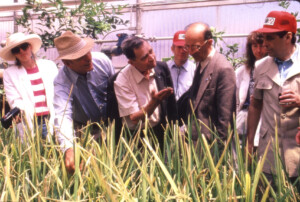
Russian pioneers in space life support: Dr. Yeygeny Shepelev, first person to live in a closed ecological system, Academician Oleg Gazenko, head of IBMP, Moscow and Dr. Josef Gitelson, head of Institute of Biophysics, Krasnoyarsk, visit Biosphere 2 research greenhouses, 1987. Also in photo John Allen, Deborah Snyder, Linda Leigh and Mark Nelson.
Early design workshops decided the “wilderness areas” of Biosphere 2 would include a tropical rainforest, savannah, thornscrub, coastal desert, freshwater to mangrove marsh and a mini-ocean with a coral reef. The farm would have to go beyond organic standards in excluding any potentially toxic substances since all water and air would be recycled in a facility designed for one hundred years of operation.
Facilities for the Biospheric Research and Development Center were soon designed and built, including greenhouses for rainforest and other biome plants and farm experiments. The project got permission from the state of Arizona to import plants and animals and erected several quarantine greenhouses. The St. Louis Botanical Garden redid its tropical greenhouses, and Dr. Peter Raven generously donated many taller specimens for Biosphere 2 biomes. In addition, the IE tropical rainforest project, Las Casas de la Selva, supplied many plants, and expeditions were mounted to collect thornscrub species and coral reef organisms in Mexico; mangrove/marsh plants and animals in the Everglades in Florida; and coastal fog desert species in Baja California, as well as collecting trips to Brazil and Guyana. The years of project design brought together very innovative engineers and world-class ecologists. Each had to learn the other’s language to work together. The engineers had to learn that not only were daunting challenges to be met, but also how to seal nearly perfectly a 3-acre (1.2 hectare) facility with roofs up to 80 feet tall (25 m) and glass panels, which would experience summer temperatures above 100 degrees F and occasional freezing conditions at the 3900 ft (1000 m) site location.
Technology learned its place—everything that went into Biosphere 2 had to support life without causing pollution by-products that the life inside couldn’t process. Conventional pumps couldn’t be used for ocean circulation, but instead vacuum pumps were designed to suck up and gently release thousands of gallons of ocean water every few minutes. Meanwhile, the ecologists grappled with how to build robust and species-packed food chains to allow for species losses. And 15 biospherian candidates worked to learn all that would be needed when a crew of eight managed a miniworld and fed themselves from barely half an acre of farm.
A five-level cybernetic system (nerve system) was developed by SBV and Hewlett-Packard to automate much of the technical interface with the life systems and to archive and process information from approximately 1,900 data points distributed throughout Biosphere 2. The nerve system is distributed both inside Biosphere 2 and in the nearby Mission Center building, and it is linked together by a computer network.
In 1986 a Test Module was constructed to first test sealing and technical systems and then for several years of ecological experiments. In 1987, John Allen (Vertebrate X) did the first human enclosure experiment for 3 days, followed by Gaie Alling (7 days, Vertebrate Y) and Linda Leigh for 21 days (Vertebrate Z).
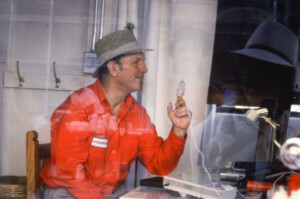
John Allen during his Vertebrate X experiment in the Biosphere 2 Test Module.
To solve how to recycle all the wastewater, the project enlisted the constructed wetland pioneer, Dr. Billy Wolverton of NASA Stennis Center. Prof. Heinrich Bohn of the University of Arizona transmitted how soils could be used to ensure trace gases didn’t build up in the atmosphere and that technology was tested at ERL and in the Test Module. The entire Biosphere 2 farm would be engineered as a soil biofilter to prevent a disastrous sick building syndrome in a system that would achieve an engineering marvel with less than 10% air exchange per year (one percent per month).
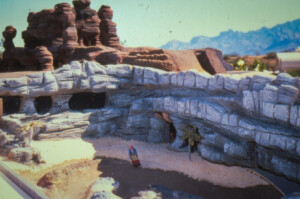
Biosphere 2 under construction. Foreground: ocean and beach, Rear: cliff faces of rainforest and savannah, rainforest mountain.
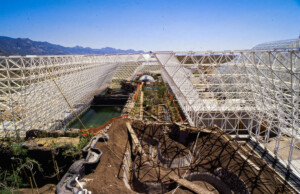
Looking along the wilderness side of Biosphere 2. Peter Pearce, who had worked with R. Buckminster Fuller, designed and made the spaceframes.
By January 1, 1987, planting in the still under construction Biosphere 2 facility began. It was a time of ecology with hard hats as roofers installed over 6000 six-foot-on-a-side glass space- frames while engineers constructed streams and ecologists planted the thousands of species of plants that Biosphere 2 would start with. Cranes lifted large boxes containing rainforest trees into the facility for planting.
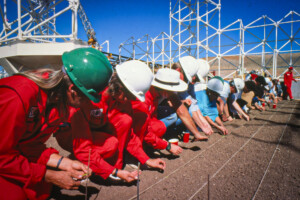
First planting, Biosphere 2 Intensive Agricultural Biome, 1 January 1986.
A greenhouse built for the Everglades marsh and mangrove plants housed 1-meter cubed containers with a water circulation system to keep them alive. Semi-trailers with artificial lights and circulating water piping brought corals 1700 miles from Akumal, along the Yucatan coast, to the Biosphere 2 ocean, accompanied by Mexican police cars to ensure they arrived as quickly as possible. Almost everything that was being done was considered by conventional wisdom to be impossible. By September 1991, a crew of eight biospherians prepared to enter Biosphere 2 for its shakedown cruise, a two-year experiment.
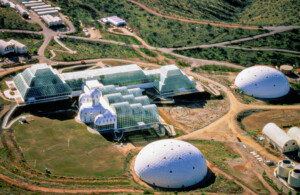
Biosphere 2 facility with two domed lungs and research and development center at top left.
For further reading:
Abigail Alling, Mark Nelson, Sally Silverstone, 2020. Life Under Glass; Crucial
Lessons in Planetary Stewardship from Two Years in Biosphere 2, 2 nd edition,
Synergetic Press, Santa Fe, NM.
Mark Nelson, 2018. Pushing Our Limits: Insights from Biosphere 2, University of
Arizona Press, Tucson.
John P. Allen, Me and the Biospheres: A Memoir by the Inventor of Biosphere 2,
2009, Synergetic Press, Santa Fe, NM.