
Voyage to Antarctica (1986–1989)
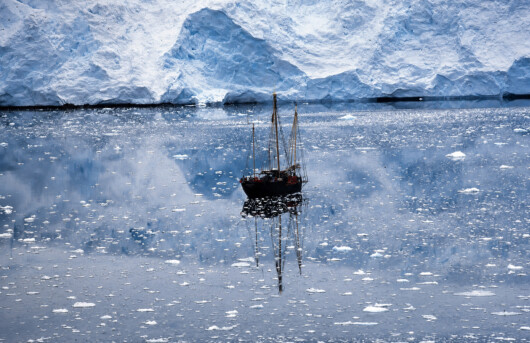
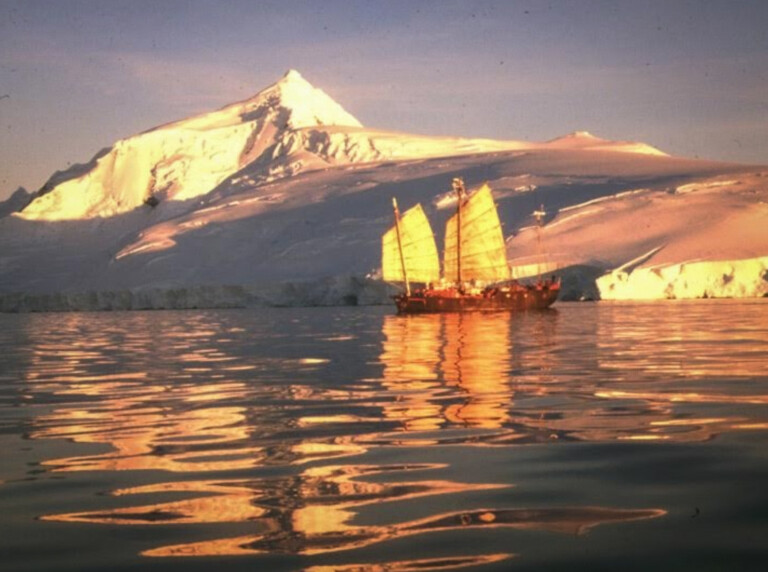
During the Expedition to Circumnavigate South America (ECSA), the Heraclitus crossed the Drake Passage and spent roughly six weeks working off the Antarctic Peninsula. There the young fifteen-person crew carried out population-genetics sampling and photo-identification of Southern humpback whales and made under-ice dives before witnessing the fragility of the region firsthand in the wake of a major Antarctic oil-spill disaster.
Achievements
- Completed one of the rare small-vessel sailing expeditions to the Antarctic Peninsula, navigating the Chilean inland waterways and crossing the Drake Passage from Cape Horn.
- Conducted population studies of the Southern humpback whale—obtaining skin-biopsy samples with crossbow-fired darts (a minimally invasive technique) and photo-identifying and documenting individual whales—for genetic analysis by Dr. Stephen O’Brien of the U.S. National Cancer Institute, in connection with the International Whaling Commission. Recorded the songs of humpback whales earlier in the voyage, in Ecuadorian waters near the Islas de los Muertos, while heading south along the Pacific coast.
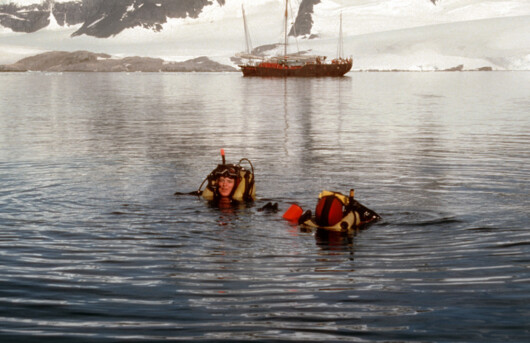
- The crew carried out cold-water and under-ice diving studies, with divers in dry suits exploring icebergs and remaining 20–30 minutes in near-freezing Antarctic waters.
- Used the long passage south along the Pacific coast of South America to train members of the Biosphere 2 project in seamanship and expedition fieldwork.
- Produced a firsthand account of the ecological vulnerability of the polar marine environment, having operated in the same waters where the Bahía Paraíso ran aground and sank.
The voyage
The Antarctic leg formed part of the Heraclitus’ broader Circumnavigation of South America Expedition, undertaken under the auspices of the Institute of Ecotechnics with marine biologist Abigail Alling serving as Expedition Chief. To withstand the conditions ahead, the ship — built in 1975 as a 25-metre ferrocement vessel as a Chinese junk — was insulated against polar cold for Antarctic weather. It carried a notably young crew, with more women than men aboard. Its first leg, running south along the Pacific coastline of South America, doubled as a training voyage for visiting members of the Biosphere 2 project, who learned seamanship and field methods alongside the regular crew. It was on this southbound passage, in Ecuadorian waters near the Isla de los Muertos, that the crew recorded the songs of humpback whales — fittingly, since humpbacks sing chiefly on their warm-water breeding grounds rather than on the cold Antarctic feeding grounds to come.
Reaching the southern tip of the continent meant threading the notoriously difficult Chilean Inland waterways, the maze of narrow fjords and channels along Patagonia’s coast. Through these tight passages the crew kept rotating watches on constant alert, manoeuvring the ship safely where a moment’s inattention could end in disaster put the ship on the rocks. On New Year’s Day 1989, outfitted against extreme cold and fully provisioned with food, water, and emergency rations sufficient for the fifteen-person crew for several months, the Heraclitus set out, passing Cape Horn and beginning a ten-day crossing of the Drake Passage — one of the roughest stretches of open ocean on Earth — to Antarctica.
Once in Antarctic waters, the central scientific work began: studies of the Southern humpback whale. Humpbacks migrate to the Southern Ocean in the Austral Summer to feed on krill, and the species was still recovering from the devastation of twentieth-century commercial whaling, making its population structure and genetic diversity questions of real urgency. To study them, crew members followed the whales in outboard-powered inflatable boats and fired small darts from a crossbow into the blubber just behind the dorsal fin. The darts, tethered by cord, were reeled back in, carrying a small plug of skin and tissue—a biopsy method that samples a living animal without serious harm. The specimens were stored in the ship’s freezer for genetic analysis by Dr. Stephen O’Brien, the geneticist associated with the U.S. National Cancer Institute and the International Whaling Commission, whose work helped illuminate the population genetics of recovering whale stocks. Alongside the biopsy work, the crew also photo-identified and documented individual whales, building a visual record of the animals to complement the genetic samples.
The expedition was not only about whales. During the ship’s six-week sojourn in Antarctica, a diving team explored icebergs from below, wearing dry suits that allowed them to descend into the freezing sea and remain submerged for twenty to thirty minutes at a time—a demanding feat in water near the freezing point, where exposure is measured in minutes rather than hours.
After several days working near the United States scientific research base at Palmer Station, on Anvers Island, the Heraclitus put out to sea voyaging back north, heading for the Falkland Islands. Soon afterward it received a radio transmission reporting that a large Argentine naval supply vessel had run aground and sunk close to the very waters where the crew had been following the whales. The ship was the Bahía Paraíso, which struck rocks near Palmer Station at Arthur Harbor on 28 January 1989 and went down, releasing an estimated 600,000 litres of diesel fuel into the surrounding sea — one of the worst environmental disasters ever recorded in Antarctica.
The diesel slick spread through the harbor, killing krill, limpets, and other invertebrates and oiling seabirds; dead and dying Adélie penguins and cormorants appeared within days, and surveys later recorded heavy chick mortality among cormorants and South Polar skuas. The contamination was concentrated within a few kilometres of the wreck and largely played out over several weeks, the volatile fuel dispersing in the high-energy waters, but for the Heraclitus crew the event drove home two lessons at once: the sheer difficulty of navigating these southern waters, and the extreme fragility of an ice-region ecosystem, where even a localised wreck could inflict lasting harm on a pristine and sensitive stretch of coast.
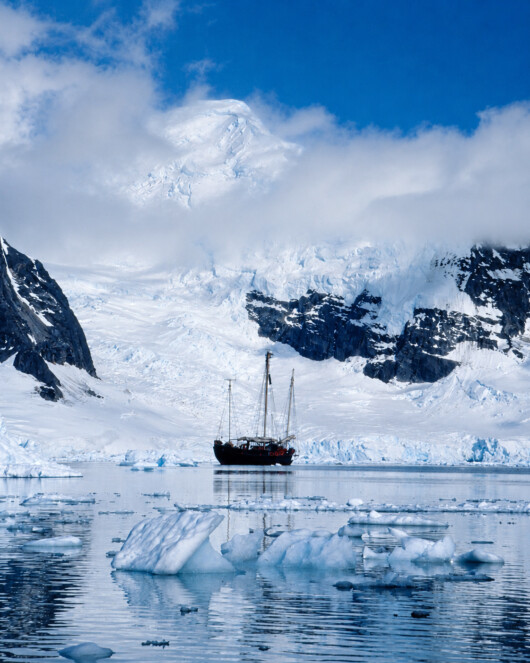
From Antarctica the Heraclitus turned north, making for the Falkland Islands and then continuing up the Atlantic coast of South America to Fortaleza, Brazil, closing out the polar chapter of its long circumnavigation.
Whale blubber tanks Deception Island, journal entry by Christine Handte
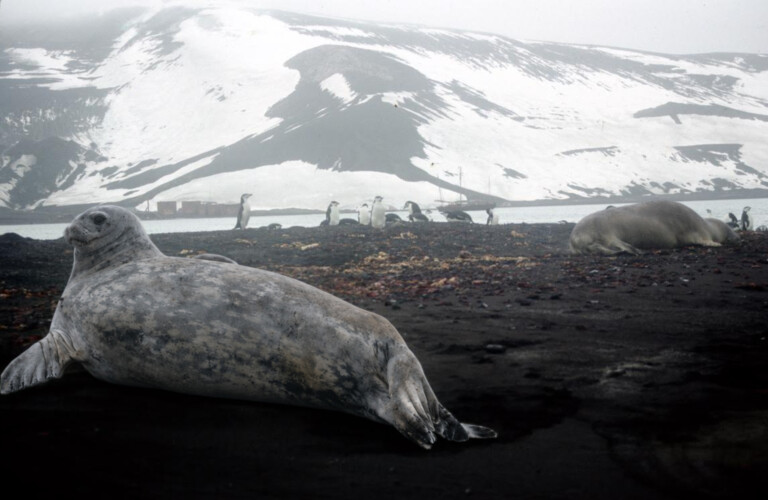
The atmosphere was gory in Deception Island. It teemed with life…a huge penguin colony, seals, whales, small scientific teams in tiny camps spread over the island…but what stood out most was that it was a whaling camp. The bay must have been red with blood. There was a creepy feeling of death. Heraclitus was anchored at Deception Island, inside an extinct volcanic crater. There were large whale blubber tanks. As big as water reservoirs, these tanks used to be filled with whale blubber used for lamp oils and for ladies’ cosmetics. Six of us entered the blubber tanks and started vocalizing. The tanks had excellent acoustics and our singing became the wailing of all the hunted whales…
The Crew on this expedition: Gaie Alling, Klaus-Peter Eiberle, Marius Pfeiffer, John Horniblow, Richard Horniblow, Reka Komaromi, Christine Handte, Isolde Drosch, Dara Hamilton, Pascale Maslin, Michelle (from Belgium), Malone Hodges, Goga Malic, George Lawton, Ian Bondsmith.
Photo Credits: Christine Handte, Isolde Drosch, John Horniblow and others