The First Successful Release of Captive Dolphins to the Wild
In 1987, the research vessel Heraclitus participated in a landmark achievement in marine conservation: the first successful, fully documented reintroduction of long-term captive dolphins back into the wild.
Working under contract to the Oceanic Research and Communication Alliance (ORCA) and operated at the time by Ocean Expeditions Inc., Heraclitus provided logistical, scientific, and field support for a pioneering rehabilitation and release program involving two Atlantic bottlenose dolphins (Tursiops truncatus), Joe and Rosie.
The project brought together an unusual coalition of marine biologists, cetacean researchers, conservationists, veterinarians, trainers, and government agencies. It represented the first time a release of previously captive dolphins had been undertaken through a carefully designed program of behavioral rehabilitation, environmental re-acclimatization, and post-release monitoring, with the approval and cooperation of state and federal authorities. Contemporary reports note that the permit issued for Joe and Rosie was the first federal permit specifically authorizing the preparation of captive dolphins for release to the wild.
The operation anticipated many of the principles that today underpin marine mammal rehabilitation and reintroduction programs: gradual transition to natural environments, recovery of survival skills, minimization of human dependence, voluntary release, and long-term monitoring.
The project was documented by National Geographic and became one of the most influential early examples of cetacean reintroduction science.
Scientific and Conservation Achievements
First Documented Captive-Cetacean Release Protocol
The Joe and Rosie project established one of the first comprehensive protocols for the rehabilitation and release of long-term captive cetaceans. Rather than simply releasing animals into open water, the program incorporated behavioral retraining, environmental acclimatization, physical conditioning, social integration opportunities, veterinary oversight, and post-release monitoring. Many of the concepts tested during the project would later become standard considerations in marine mammal rehabilitation and reintroduction programs worldwide.
Demonstration of Behavioural Recovery
One of the project’s principal scientific questions was whether dolphins that had spent years under human care could recover essential wild behaviors. The rehabilitation program demonstrated that captive dolphins could relearn live-fish hunting, adapt to natural tidal systems, regain physical fitness, and interact successfully with wild dolphins. Within days of release, both dolphins were observed associating with local wild pods.
Contribution to Reintroduction Biology
At the time, relatively little scientific guidance existed regarding the release of long-term captive marine mammals. The Joe and Rosie project became an important case study in the emerging discipline of wildlife reintroduction biology, helping inform later discussions concerning rehabilitation, welfare, release criteria, monitoring methods, and the ethical responsibilities associated with captive animals.
Evidence of Long-Term Reintegration
The strongest measure of success in any wildlife reintroduction program is successful integration into a breeding population. Following the release, Rosie was repeatedly observed associating with wild dolphins. Subsequent reports indicated that she was later sighted with a calf, suggesting successful social and reproductive integration into the wild population. Although long-term monitoring was limited, the observation became an iconic symbol of the project’s success and remains one of the earliest indications that captive dolphins could return to a natural reproductive life following rehabilitation.
Joe and Rosie
Joe and Rosie were captured as young dolphins in the Gulf of Mexico in 1980 and became participants in the JANUS Project (Joint Analogue And Numeric Understanding System), led by neurophysiologist and cetacean researcher Dr. John C. Lilly. The JANUS Project explored the possibility of communication between humans and dolphins using advanced signal-processing technologies and language-learning experiments. During their years in the program, Joe and Rosie reportedly acquired a working understanding of dozens of spoken English words and became widely known for their responsiveness to human interaction.
Their intelligence, curiosity, and ability to engage with children and people with disabilities made them popular ambassadors for dolphin research. Yet Dr. Lilly had always maintained that the dolphins should ultimately be returned to the sea once the research program concluded. When the JANUS Project ended, responsibility for fulfilling that commitment passed to ORCA.
The ORCA Project
The Oceanic Research and Communication Alliance (ORCA) was formed to undertake the unprecedented challenge of returning the dolphins to the wild. The project was led by Virginia Coyle and James Hickman, with marine biologist Abigail Alling playing a central role in identifying and evaluating release sites. Ornithologist Duarte Câmara, Ric O’Barry, and other specialists contributed to planning and implementation. Alling conducted extensive surveys of Georgia’s coastal estuaries and tidal marsh systems, eventually identifying a remote site near Wassaw Island as an ideal release location. The area supported abundant fish populations, strong tidal currents, and a resident population of wild bottlenose dolphins, while remaining sufficiently isolated to minimize disturbance from human activity. The Heraclitus was contracted to provide field support for the operation and became the principal logistical platform for the release effort.
Building a Dolphin “Halfway House”
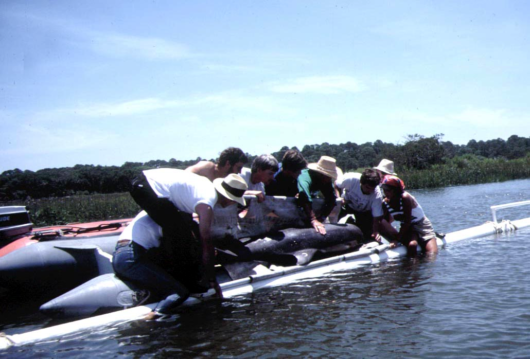
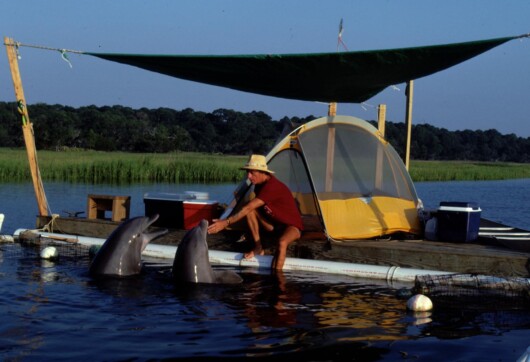
A central innovation of the project was the creation of a transitional marine habitat designed to bridge the gap between captivity and complete freedom. Using PVC pipe and marine netting, the Heraclitus crew constructed a large sea pen within the tidal estuary. Unlike a conventional dolphin enclosure, the structure allowed tides, fish, sounds, and scents from the surrounding ecosystem to pass freely through. The pen enabled Joe and Rosie to experience natural environmental conditions while remaining protected during their rehabilitation.
To further ease the transition, underwater sound recordings from the Georgia estuary were played to the dolphins before relocation, familiarizing them with the acoustic environment they would soon encounter in the wild.
Relearning How to Be Wild
Responsibility for behavioral rehabilitation fell largely to Ric O’Barry, the former trainer of the dolphins used in the television series Flipper. By the mid-1980s O’Barry had become one of the world’s most prominent advocates for dolphin welfare and captive-dolphin reform. Rather than teaching new behaviors, his task was to reverse years of conditioning and restore natural instincts. The rehabilitation program focused on reducing dependence on humans and rebuilding essential survival skills. Live fish were gradually introduced into the dolphins’ diet. Initially their prey was slowed to facilitate capture, but increasingly difficult hunting opportunities encouraged the dolphins to recover natural foraging behaviour. The strong tidal currents of the Georgia estuary provided a natural conditioning system, requiring the animals to swim against moving water and rapidly rebuild strength and endurance. As O’Barry later described it, the goal was not to train dolphins but to allow them to become dolphins again.
The Release
In June 1987, Joe and Rosie were transported by Army helicopter from Florida to the Georgia release site in specially designed lifting harnesses. For approximately four weeks they remained within the estuarine sea pen while continuing rehabilitation and acclimatization.
By July both dolphins had regained fitness, were successfully catching live fish, and were exhibiting increasingly natural behavior. Wild dolphins frequently passed nearby, creating opportunities for social contact and acoustic communication. On 13 July 1987, the gate was opened. Unlike many previous attempts to free captive cetaceans, Joe and Rosie were not forced into open water. The gate simply provided a choice. After a brief period of exploration, both dolphins voluntarily left the enclosure and entered the surrounding estuary. Within days they were observed traveling independently and interacting with local wild dolphins. Subsequent sightings confirmed that both animals had survived the transition and were behaving as free-ranging dolphins.
Rosie’s Calf
The most celebrated chapter of the story emerged in the months following the release.
Rosie had been pregnant during the latter stages of the rehabilitation program, and project members hoped she would ultimately give birth in the wild rather than under human care. Shortly after release she was observed associating with wild dolphins. Later reports indicated that Rosie had successfully produced and cared for a calf in the wild. For conservation biologists, reproduction is one of the strongest indicators of successful reintegration. Survival alone demonstrates adaptation; successful reproduction demonstrates participation in a functioning wild population. For the project team, Rosie’s calf became the ultimate confirmation that the release had achieved its goal.
Legacy
The release of Joe and Rosie marked a turning point in the history of marine mammal conservation. The project demonstrated that long-term captive dolphins could, under carefully managed conditions, recover essential behaviors, integrate with wild populations, and potentially reproduce in the wild. It helped shift discussions about dolphins away from exhibition and toward welfare, rehabilitation, and conservation.
The protocols developed through the project influenced later cetacean release efforts around the world and remain an important milestone in the history of marine mammal reintroduction science. For Heraclitus, the project represented another example of the vessel’s unusual role at the intersection of exploration, science, and environmental stewardship: helping not merely to study the natural world, but, in this case, to return two remarkable animals to it.