
IE worked with Institute of Biophysics to organize the Second International Workshop on Closed Ecological Systems in Moscow and Krasnoyarsk, Siberia, in September 1989. But this took some clever diplomacy. Krasnoyarsk is a heavily industrialized and militarized city, and the location of a missile radar installation, that the Soviets finally admitted was in violation of US-USSR arms control agreements. It was a closed city, even for ordinary Soviet citizens. Unfortunately, the Institute of Biophysics and their Bios-3 facility were located a short drive from the city.
Gorbachev paid a visit to IBP in 1988. While there, Josef and his team showed him messages from Biosphere 2 and explained that their colleagues in the West were very eager to see the advanced life support work there. The Soviet leader agreed, and plans could advance for the meeting.
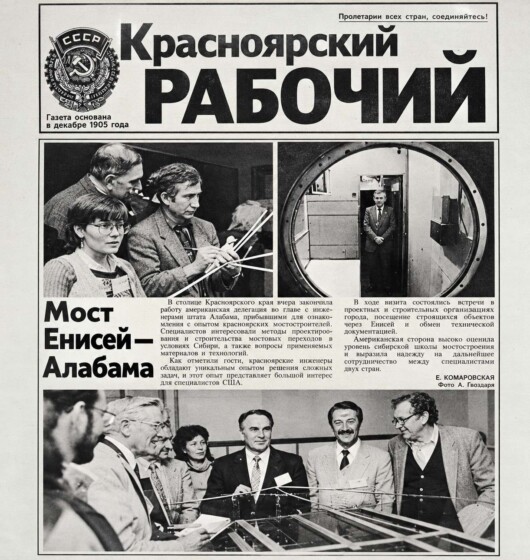
The ‘Krasnoyarsk Worker’ Newspaper
Top left: John Allen whispering to author, (top right) Walter Adey, of the Smithsonian Marine Systems Lab, consultant to Biosphere 2’s ocean/marsh, (below) group around Bios-3 model includes Frank Salisbury, Utah State Univ. NASA crop breeder, Henry Lisovsky, and Carl Hodges, Univ of Arizona Environmental Research Laboratory
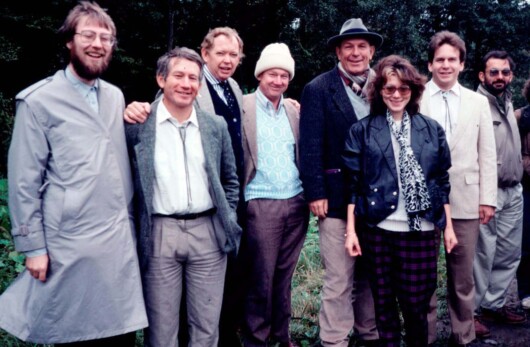
Some of the outside scientists at 2nd International workshop, Krasnoyarsk:
From left: Anders Hansson, Sheffield University, author, Carl Hodges, Walter Adey, John Allen, Taber MacCallum, Biosphere 2, Roger Binot, ESA, Frank Salisbury, Utah State University.
At the meeting, the IBP researchers reviewed the extraordinary research with their Bios-3 closed eccological system facility starting in the late 1960s. They were truly far ahead of anyone else in the field. During their experiments, a dozen crops produced up to 70% of the food, and fully regenerated oxygen and water. Frank Salisbury reported on the wheat plant breeding his team at Utah State University was doing for NASA. They produced incredibly productive, early maturing ultra-dwarf wheat varieties which permitted dense plantings.
Roger Binot reported on the European Space Agency’s space life support programs. As a microbiologist, he was involved in researching how microbes could complete nutrient cycles by digesting human wastes and purifying trace gases to maintain a healthy atmosphere. In 1989, ESA launched their MELiSSA (Micro-Ecological Life Support System Alternative) project, simulating a terrestrial ecosystem and dividing it up into separate compartments they would eventually join together. Our large Biosphere 2 delegation shared our progress and current research priorities. The facility was well into construction and the insertion of soils and plants into the biomes had just begun.