RV Heraclitus: Coral Reef Expeditions (1991–2006)
For approximately fifteen years, coral reefs became the principal focus of the research vessel Heraclitus. Operating first under the Planetary Coral Reef Foundation (PCRF) and later the Biosphere Foundation, The ship served as a versatile base for coral-reef studies around the world, working with researchers of the Planetary Coral Reef Foundation (PCRF) and scientists from institutions including Scripps Institution of Oceanography, Columbia University, MIT, and Boston University at more than 40 sites across the Red Sea, Indian Ocean, and Pacific.
RV Heraclitus supported one of the earliest large-scale efforts to document coral-reef conditions on a planetary basis.
Beginning with the collection of living reef organisms for the ocean biome of Biosphere 2, the program evolved into a global network of reef-monitoring stations spanning more than forty sites throughout the world’s tropical oceans. Research included reef ecology, coral health assessment, mangrove studies, reef mapping, satellite-based monitoring, biodiversity documentation, and paleoclimate investigations using coral-core archives.
At a time when concerns about coral bleaching and climate change were only beginning to emerge, Heraclitus helped establish baseline ecological data that would later prove invaluable for understanding long-term changes in coral reef ecosystems.
Collections for Biosphere 2 (1990–1991)
In 1991, Heraclitus participated in the documentation, collection, and transport of living coral-reef organisms for the construction of the ocean biome of Biosphere 2 in Arizona.
Working at two principal collection sites—Mayaguana in the Bahamas and Akumal on the Caribbean coast of Mexico—the expedition gathered live corals, sponges, reef invertebrates, fishes, algae, and associated marine organisms destined for the world’s largest closed ecological research facility.
In Mayaguana, the expedition worked alongside the research vessel Marsys Resolute of the Smithsonian Institution. The collections represented one of the most ambitious attempts ever undertaken to recreate a functioning coral reef ecosystem under controlled conditions and provided an unprecedented opportunity to study the dynamics of reef communities within a closed biospheric environment.
Central America and Caribbean Reef Studies (1991–1995)
Following the Biosphere 2 collections, Heraclitus continued reef investigations throughout the Caribbean Basin. After voyages through the Bahamas, Lesser Antilles, Venezuela, Mexico, and Florida, the vessel established a long-term operational base in Belize.
Working closely with the Fisheries Department of Belize and coral ecologist Dr. Phil Dustan of the College of Charleston, Heraclitus served as the principal field platform for studies of Turneffe Atoll and the Belize Barrier Reef system.
Research focused on reef health, coral-community structure, and ecological interactions among coral reefs, seagrass beds, and mangrove forests.
Mangrove leaf-litter traps were established to collect samples for Matt Finn of the Smithsonian Institution, whose work contributed to Biosphere 2 research. Dr. Josef Gitelson, Director of the Institute of Biophysics of the Russian Academy of Sciences in Krasnoyarsk, joined the project to investigate algal productivity and reef metabolism.
These studies helped demonstrate the critical ecological relationship between mangrove forests and adjacent coral reefs, revealing how mangroves support fisheries productivity, nutrient cycling, shoreline stability, and reef resilience.
During this period coral reefs became the defining scientific mission of Heraclitus, a role the vessel would maintain for the next fifteen years.
Indian Ocean and Southeast Asia Coral Reef Mapping Expedition (1995–2000)
In 1995, Heraclitus departed Belize and Puerto Rico, crossed the Atlantic Ocean and Mediterranean Sea, and entered the Red Sea to begin one of the most ambitious coral-reef expeditions undertaken at the time.
The expedition formed part of a developing international effort coordinated by the Planetary Coral Reef Foundation and co-founder Abigail Alling to create a comprehensive global baseline of coral reef health.
The voyage began with reef surveys in Hurghada, Egypt, and Aqaba, Jordan. Field data collected by expedition divers were transmitted to Dr. Phil Dustan’s laboratory, where quantitative analyses of reef condition were conducted.
The vessel continued south through the Red Sea, visiting the site of Jacques Cousteau’s former underwater habitat Conshelf II near Sudan before proceeding to Yemen and then Oman, where reef assessments were conducted in several locations.
From Arabia the expedition crossed the Indian Ocean to Mumbai, India, followed by extensive work in the Maldives and Kenya.
In Sri Lanka, long-time expedition supporter and science-fiction author Sir Arthur C. Clarke once again provided assistance and local support, continuing a relationship that had begun during earlier Heraclitus expeditions.
The voyage then moved into Southeast Asia, carrying out reef studies in Indonesia, Malaysia, and Vietnam.
Singapore became the expedition’s principal Southeast Asian base of operations through Raffles Marina. While there, Heraclitus participated in the Singaporean Aseanarean Expedition while continuing coral-reef surveys throughout the region. A three part National Geographic Film documented the Aseanarean Expedition, one of them featuring Heraclitus.
Major repairs and refits were completed in Darwin, Australia, before the vessel continued to Bali, arriving during the Bali 2000 celebrations and marking the completion of the five-year Indian Ocean and Southeast Asian expedition.
Global Reef Monitoring and Remote Sensing Program (1995–2006)
One of the most important scientific achievements of the coral expeditions was the development of new methods for monitoring coral reefs on a planetary scale.
Working with Dr. Phil Dustan, scientists from MIT and Scripps Institution of Oceanography, and coordinated through Abigail Alling and the Planetary Coral Reef Foundation, Heraclitus became a field platform for integrating direct underwater observations with emerging satellite remote-sensing technologies.
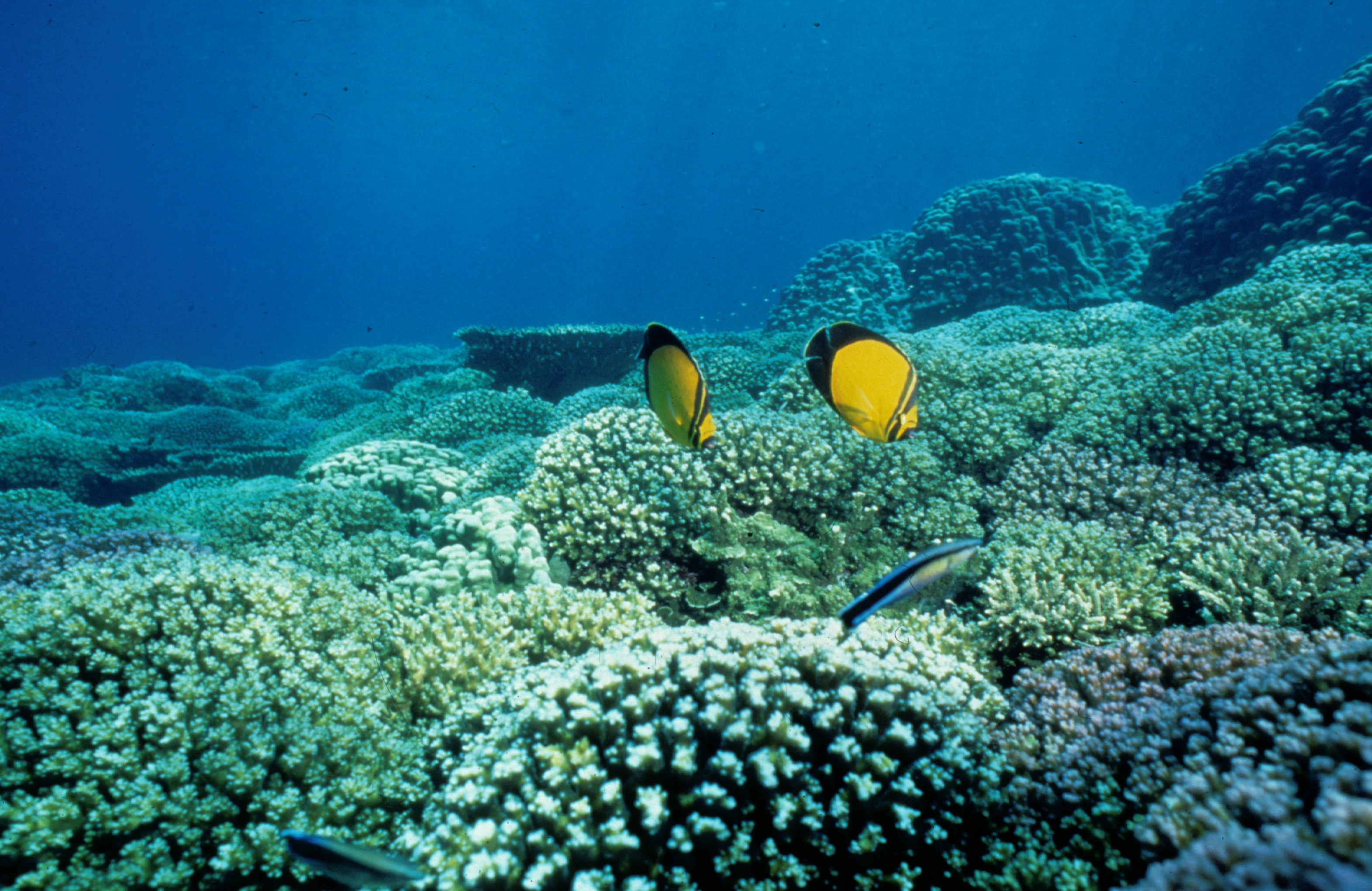
Standardized ecological measurements were collected at more than forty reef sites throughout the Red Sea, Indian Ocean, Southeast Asia, and Pacific.
The resulting data contributed to the first comprehensive baseline mapping effort of living coral reefs worldwide and helped establish methods that would later become fundamental to large-scale reef monitoring programs.
Repeated measurements of coral cover, species diversity, reef vitality, and environmental conditions allowed scientists to track changes through time and compare reef health across multiple ocean basins.
Coral Paleoclimate Research (1995–2000)
In collaboration with Columbia University and Scripps Institution of Oceanography, Heraclitus supported a major paleoclimate research program using coral cores as natural archives of environmental history.
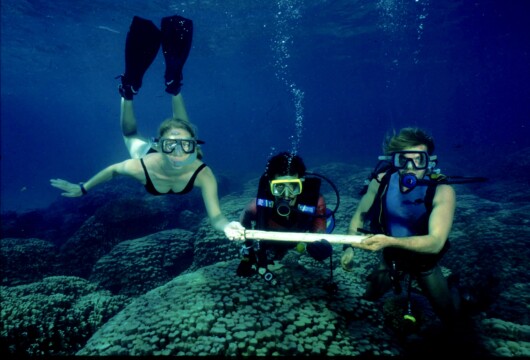
Divers extracted long cylindrical cores from massive reef-building corals throughout the Red Sea, Indian Ocean, and Southeast Asian archipelagos.
Much like tree rings, coral skeletons preserve annual and seasonal chemical records of environmental conditions. By analyzing isotopic and growth-band signatures preserved within the coral skeletons, researchers reconstructed past sea-surface temperatures, rainfall patterns, ocean circulation dynamics, and El Niño-Southern Oscillation events.
These records contributed to a growing understanding of natural climate variability and provided valuable context for evaluating contemporary climate change.
Pacific Coral Reef Expedition (2001–2006)
Following completion of the Indian Ocean program, Heraclitus, now operated by the Biosphere Foundation, continued coral-reef exploration throughout the Pacific Ocean.
Research expanded into the Coral Sea, Papua New Guinea, the Solomon Islands, Fiji, and other remote Pacific archipelagos, with Heraclitus serving as a floating research station for marine scientists and expedition teams.
One of the most remarkable achievements of this period was a 152-day trans-Pacific passage from Guam to Seattle, the longest voyage ever undertaken by the vessel.
From Seattle the ship sailed south to the Channel Islands and San Francisco Bay, returning to Oakland—where Heraclitus had been built twenty-eight years earlier.
The return was celebrated near Jack London Square with Oakland Mayor Jerry Brown, expedition supporters, and filmmaker James Cameron, marking a quarter century of exploration and scientific research.
Following maintenance and repairs in Los Angeles and Ensenada, Mexico, Heraclitus once again crossed the Pacific.
The Biosphere Foundation continued reef studies from the Marquesas Islands across the South Pacific, including extensive work in Rarotonga and other island groups before the expedition concluded in Cairns, Australia.
Documentary Films
- The Coral Dance
- Le Dragon des Mers
Together, these expeditions established Heraclitus as one of the few vessels to conduct sustained, multi-ocean coral-reef research over such an extended period. Long before global coral bleaching became widely recognized, the vessel’s crews, scientists, and collaborators were documenting reef ecosystems across the tropical oceans, creating a valuable scientific record of coral reefs at the close of the twentieth century and the beginning of the twenty-first