
I.E. organized the Third International Workshop on Biospherics and Closed Ecological Systems for April 1992. By then, the biospherians had been inside for more than six months, breaking the record then held by Bios-3.
We had a large delegation from Moscow and Krasnoyarsk. But it was sad to be only able to speak with people through two-way radio at the glass. Still, the Russians were some of our most knowledgeable colleagues as they had plenty of experience with their own crews in isolated environments. We had such concerns about keeping CO2 from getting too high, that one day of the meeting was devoted to global climate change modeling and mechanisms to keep the atmosphere healthy in Biosphere 1 (Earth) as well as Biosphere 2.
There were several sections on the history and current work in bioregenerative life support. In one, Ganna Meleshko told us of a 30-day closure experiment at IBMP in the years following Yevgeny’s closure, in such confined conditions that the test subjects could only stand or sit down – there was not room to fully stretch out. When we asked how they had endured this, she laconically replied that it was not a problem; the volunteers were good Party members.
Josef Gitelson, in his talk at the conference, stressed the necessity for human intervention to keep the biogeochemical cycles working correctly in enclosed ecosystems. This had struck me from our first conversations in 1986 when Josef pointed out that humans inside the system are active participants in their life supporting system. It started my thinking about what it would be like to be not just a passive recipient of ecological life support, like all of us are in Earth’s biosphere, but able to work with and affect the system in which we are an integral part.
In Biosphere 2, the biospherian team has been learning how to manage this living world so that it supports our food production, our atmosphere and the health of the different biomes, all at the same time. The biospherians are not a “luxury item” in the biosphere. Using Gitelson’s perspective, humans are also needed to maintain its high level of complexity and structure. Thus, humans are both a disturbing force and a restoring force. With any human-made system, technology is needed to replace natural functions the biosphere normally does. Who else is there to operate the technosphere in service of the biosphere’s health and our own?
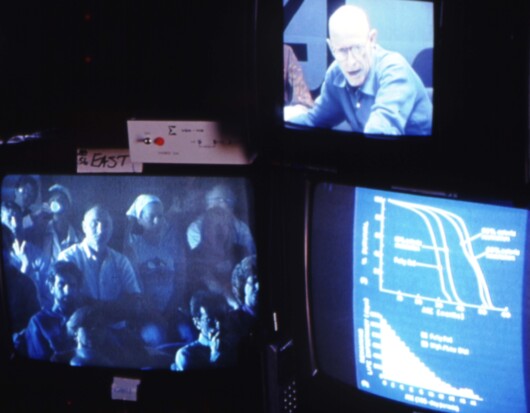
Interbiospheric dialogue. Dr. Roy Walford (top center), UCLA School of Medicine, presenting on biomedical research in Biosphere 2 to participants in the 3rd International Biospherics conference at Biosphere 2, April 1992.
-Mark Nelson