
1996 – Conference on Biospherics and Life Support
Fourth International Conference on Biospherics and Closed Ecological Systems (1996)
Held at the Linnean Society of London, the Fourth International Conference on Biospherics and Closed Ecological Systems marked the first major scientific synthesis following the completion of the two-year Biosphere 2 closure experiment (1991–1993). The conference brought together leading researchers from Biosphere 2, Russia’s BIOS-3 program, NASA, the European Space Agency, and other international institutions to compare the world’s most advanced experiments in materially closed ecological systems and bioregenerative life-support technologies.
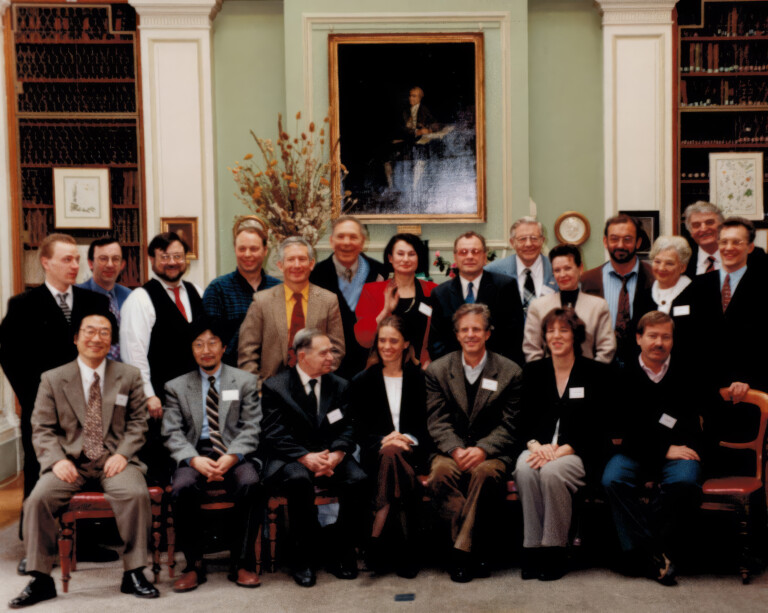
Speakers at the Linnean Society meeting, London, 1996. From left to right: back row: Mark Mills T. Heflin Jones, Craig Litton, Ray Collins, author, John Allen, Galina Nechitailo, Nicholai Pechurkin, Frank Salisbury, Lydia Somova, Roger Binot, Ganna Meleshko, Alexander Mashinsky, Sergei Zhukov. Front row: Seishiro Kibe, Tsutomu Iwata, Yevgeny Shepelev, Abigail Alling, Phil Dustan, Sally Silverstone, Andrew Brittain. Not in photo: Sir Ghillean Prance, William Dempster, William Challoner.
John Allen (Institute of Ecotechnics and Biosphere 2) opened the conference by outlining the conceptual foundations of biospherics as a new scientific discipline. He argued that miniature biospheres function as macro-laboratories for understanding the Earth’s biosphere while providing the knowledge necessary for future human settlements beyond Earth.
Dr. Mark Nelson presented the ecological and agricultural performance of Biosphere 2, describing the complete recycling of human, animal, and plant wastes within the materially closed system. He reviewed the productivity of the intensive agricultural system, nutrient cycling, and the successful production of food for the eight-member crew throughout the two-year experiment.
Abigail Alling and Linda Leigh presented detailed studies of Biosphere 2’s rainforest and coral reef ecosystems, together with investigations into one of the project’s most significant scientific discoveries—the decline in atmospheric oxygen caused by carbon dioxide reacting with exposed concrete surfaces inside the structure. Their work highlighted the complex interactions between biological, geological, and engineered systems within materially closed environments.
A panel on Atmospheric and Trace Gas Dynamics examined the accumulation of trace gases in closed ecological systems, including rising concentrations of nitrous oxide resulting from the absence of the ultraviolet radiation normally present in Earth’s stratosphere. Researchers discussed monitoring techniques and strategies for maintaining long-term atmospheric stability in future closed habitats.
The conference demonstrated how experiments in closed ecological systems extend far beyond space research. By integrating ecology, engineering, agriculture, atmospheric science, and human habitation, biospherics provides powerful experimental models for understanding the functioning of the Earth’s biosphere itself. The meeting reinforced the Institute of Ecotechnics’ vision that advances in closed ecological systems can contribute equally to planetary stewardship and humanity’s future beyond Earth.