
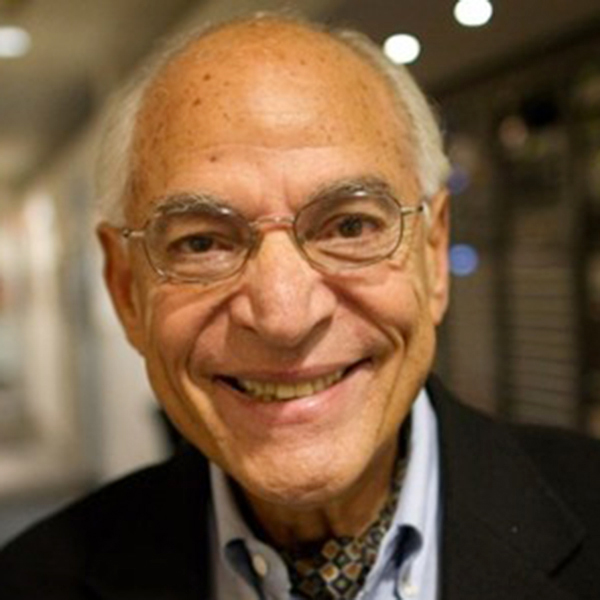
Honorary Fellow
Dr. Farouk El-Baz is a renowned Egyptian-American geologist whose pioneering work has advanced the exploration of both the Moon and the deserts of Earth. For many years, he served as Research Professor and Director of the Center for Remote Sensing at Boston University and was Professor of Geology at Ain Shams University in Cairo. Dr. Farouk El-Baz received the Michael Collins Trophy for Lifetime Achievement in March 2026.
During NASA’s Apollo program, Dr. El-Baz played a leading role in the geological exploration of the Moon. He helped select lunar landing sites and trained Apollo astronauts to make geological observations and photograph significant features from space. He later participated in joint American-Soviet space missions, with a particular focus on the study of arid regions.
Dr. El-Baz became a pioneer in the use of satellite imagery to investigate desert landscapes. His research provided important evidence that deserts are shaped by long-term climatic variation. Using satellite data and ground-penetrating radar, he identified ancient river channels buried beneath the sands of the Sahara. This work contributed to the discovery of groundwater resources in arid regions of Egypt, Oman and the United Arab Emirates.
In 1972, Dr. El-Baz joined the Smithsonian Institution, where he established and directed the Center for Earth and Planetary Studies at the National Air and Space Museum. He worked closely with several friends and colleagues of the Institute of Ecotechnics, including Dr. Eugene Shoemaker and USGS astrogeologists Dr. Jack McCauley, Dr. Carol Breed and Dr. Maurice Grolier.
Through his remarkable ability to connect planetary science, remote sensing and the practical needs of people living in arid environments, Dr. Farouk El-Baz has made an enduring contribution to our understanding of the Earth and its place within the wider solar system.