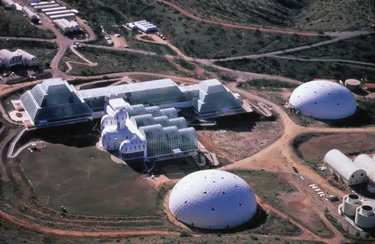
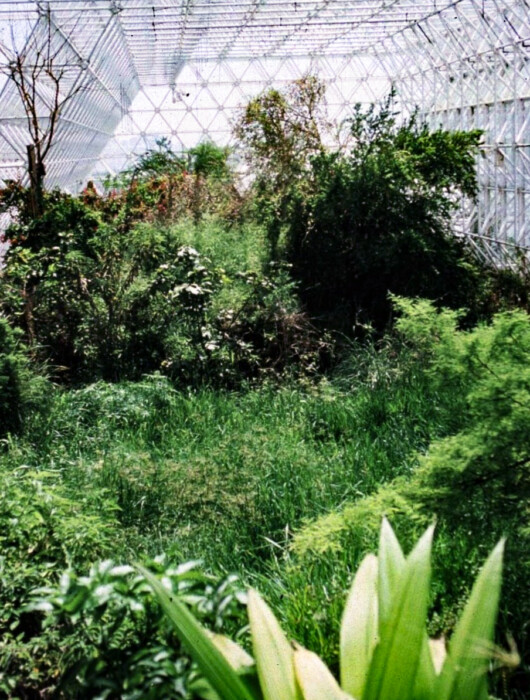
One of the landmark projects the Institute of Ecotechnics helped birth was Biosphere 2. It was the first human-designed biospheric system, a 3.15 acre materially closed world which housed analogue systems to Earth’s biomes, including a tropical rainforest, savannah, coastal fog desert, mangrove marsh and living coral reef ocean along with sustainable non-chemical farm, laboratories and living quarters for eight “biospherians.” Biosphere 2, even before the Internet, reached a vast global audience and inspired a generation with its optimistic vision and beginning understanding of the importance of our Earth’s biosphere.
Designed as a new kind of laboratory to study our global ecology, it also reflected what’s possible when great ecologists and innovative engineers work together. The selection below from my book, “Pushing our Limits: Insights from Biosphere 2” (University of Arizona Press, 2018) gives some insights into what motivated us. How learning to live in space reinforces the kind of understanding we need to improve how we live on this planet, as citizens (biospherians!) of Biosphere 1.
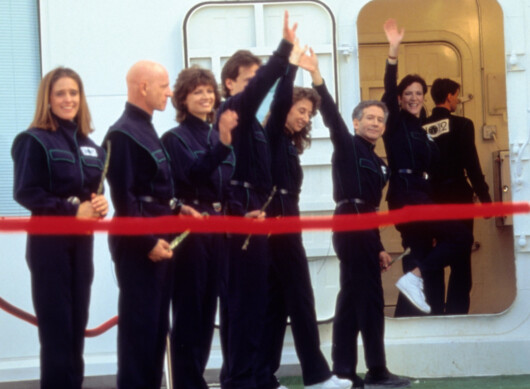
Crew enters through the airlock for the first two-year closure experiment.
In this book, I explore the legacies of Biosphere 2 and its relevance to our global ecological challenges. Pondering our relationship to Biosphere 1 led me to recall how space exploration changed human consciousness. Photos of Earth from the darkness of space stunned the world. For the first time, humanity saw the Earth, this spinning blue and white world which contains everything we value. Apollo astronauts enjoyed “Earthrise” over the horizon of the Moon. Their unique experience was called the “Overview Effect”. It was a thrilling, life-changing perspective, the first humans separated from Earth’s biosphere.
Rusty Schweickart flew on Apollo 9, testing the Lunar Lander. He served on the Biosphere 2 Project Review Committee and became a friend. He reflected on the profound impact he experienced during a spacewalk while orbiting the Earth:
“You look down there and you can’t imagine how many borders and boundaries you crossed again and again and again. At that wake-up scene – the Middle East – you know there are hundreds of people killing each other over some imaginary line that you can’t see. From where you see it, the thing is a whole, and it’s so beautiful. And you wish you could take one from each side in hand and say, “Look at it from this perspective. Look at that. What’s important?”…And you realize…that you’ve changed. That relationship is no longer what it was…Do you deserve this? This fantastic experience? You know very well and it comes through to you so powerfully, that you’re the sensing element for man… It’s a feeling that says you have a responsibility. It’s not for yourself…And when you come back, there’s a difference in that world now, there’s a difference in that relationship between you and that planet, and you and all those other forms of life on that planet, because you’ve had that kind of experience. It’s a difference, and it’s so precious…it’s not me, it’s you, it’s us, it’s we, it’s life that had that experience. And it’s not just my problem to integrate, it’s not my challenge to integrate, my joy to integrate – it’s yours, it’s everybody’s.” – Rusty Schweickart
Those images and words from the first voyagers beyond Earth were revolutionary. Now, they’re part of the fabric of reality for younger generations. The “Overview Effect” which the astronauts shared, was the crucial beginning of a realization that the whole Earth is our home. But biospheres are still a different matter. The joint venture company behind Biosphere 2 was Space Biospheres Ventures and I usually had to spell the word to people. Times have changed, and “biosphere” is used more often. I wonder though what people think of when they say the words “Earth’s biosphere”. It is a hard concept to comprehend. Our biosphere is extremely complex. Its cycles of air, water and food enable human life and all other life. We humans are an integral part of it. The biosphere is not some “environment” outside and alien to us. These realities mean the current assault on and degradation of our biosphere pose almost unimaginable risks. Astronauts who deliberately damaged their life support system would be considered suicidal nuts.
The 15 of who lived inside Biosphere 2 in Missions 1 and 2 (in 1994) and others (mainly Russians and now Chinese) who lived inside of even smaller closed ecological systems had the kind of life-altering experience that spacefarers report. But ours is not an “Overview” but an “Innerview”. We lived with, took care of, and were nurtured by a living system, a mini biosphere. All the while, we received communications and listened to news of developments between the rest of humanity and the planetary biosphere. As connection deepened with our living world, we became acutely aware of the jarring contrast between how we lived and what was happening outside. We’d hear of ecological degradation, mindless pursuit of technological advance and short-term profit, regardless of the damage inflicted. We innerly echoed what Rusty wanted to say to people fighting over national boundaries: “Look at our biosphere from this perspective. What’s important?” I want to share this amazing experience that my colleagues and I were so fortunate to have – on behalf of you, the reader, and all life. I’ll tell this story from a very personal viewpoint because I was one of eight humans, eight sensing elements in a new relationship to a biosphere, experiencing the “Innerview Effect”. The joys, struggles and insights of that inner journey need to be communicated and integrated with the challenge: learning to take care of our global biosphere.
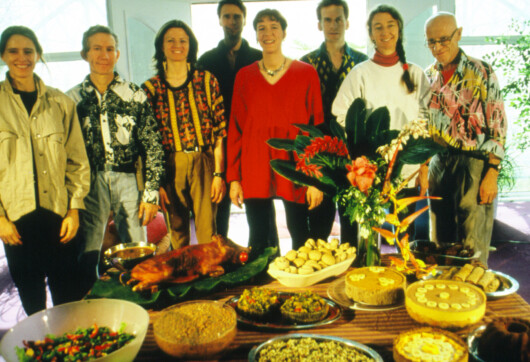
Since the crew had to endure a calorie restricted diet, to improve morale, food was put aside from harvests to enjoy feast days!
L-R: Gaie Alling, Mark Nelson, Jane Poynter, Mark Van Thillo, Sally Silverstone, Taber MacCallum, Linda Leigh, Roy Walford.
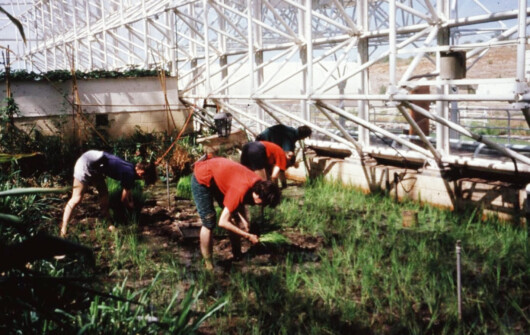
Barefoot crew planting rice seedlings in the paddies.
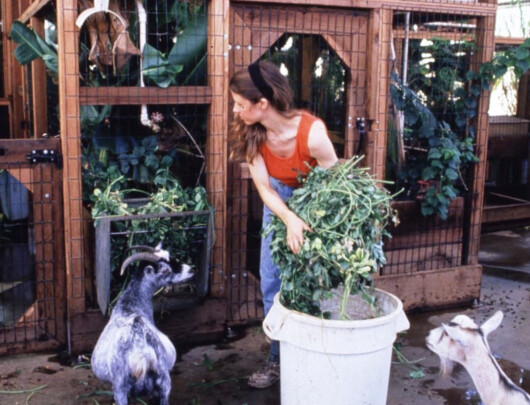
Jane Poynter feeding African Pygmy goats.
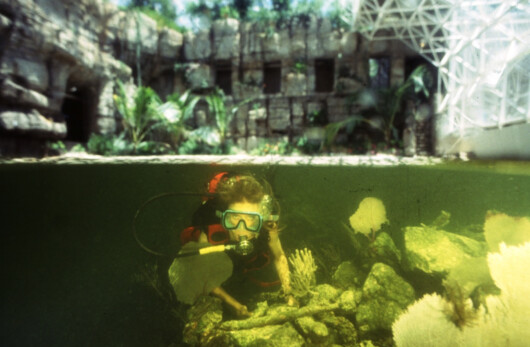
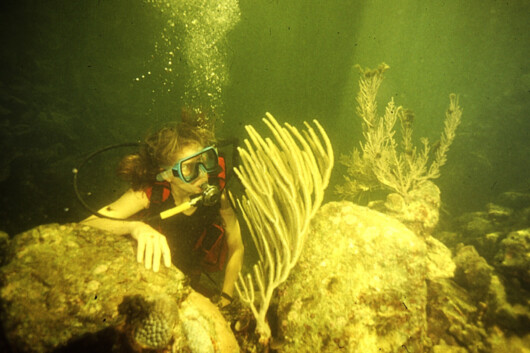
Gaie Alling, checking the health of the coral reef.
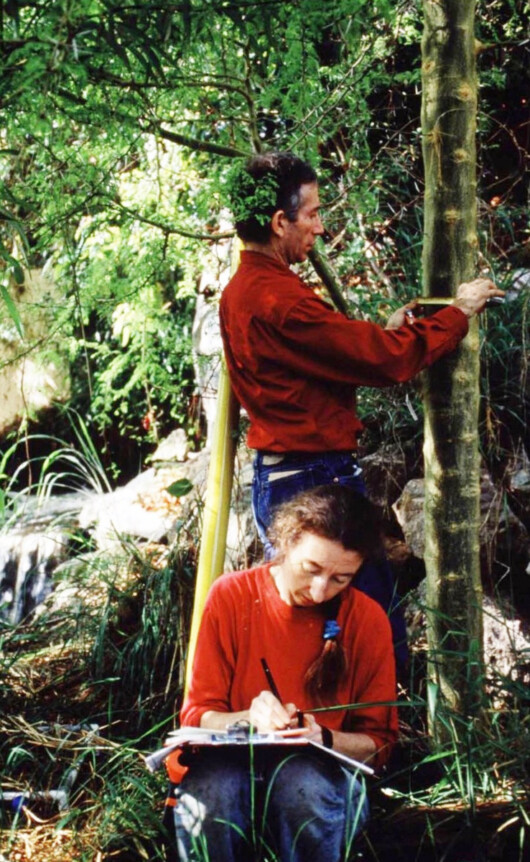
Linda Leigh and Mark Nelson measuring biomass in the savannah. Over 60 research projects were carried out in cooperation with outside scientists and institutions. Biosphere 2 thrived and biomass more than doubled during the first two years as vegetation rapidly grew.