A whole new field was opening in the 1980s when Biosphere 2 was conceived: comparative planetology. The space race propelled the United States and the Soviet Union to outdo each other with spectacular firsts: explore the rings of Saturn, land on Mars, on Venus, orbit the Sun, journey to the ends of our solar system and beyond. Spacecraft discovered oceans of water and of more exotic chemicals on other planets’ moons. Humans saw images of volcanoes erupt on a world never seen before. Line by line, the first images of distant worlds sent back by spacecraft were revealed. The exploration of Earth from space revolutionized our understanding of our planet and biosphere. This “Mission to Planet Earth” now deploys far more, and increasingly sophisticated orbiting sensors. Space exploration powered a global communications revolution making the internet possible.
Comparing planets, learning how Earth differs from our neighbors: science fiction made real.
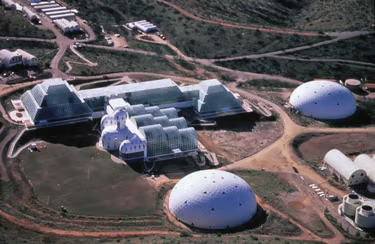
Members of the Institute of Ecotechnics began to think of the possibility and promise of comparative biospheres. We have only one biosphere to study until we find others (or they find us!) amongst the planets which orbit most stars. We started calling Earth’s “Biosphere 1” to emphasize how incredibly precious it is. Mini-biospheres could open new methods of investigating the basic laws and mechanisms governing all such systems. Though inherently complex, mini-biospheres could be studied in far greater detail than is possible with our planetary system.
All biospheres operate with photosynthesis and respiration, the water cycle, biogeochemical cycles, food chains and species interactions, soils and aquatic systems, microbial diversity, and respond to key environmental parameters like light, temperature, and seasonal changes. Mini-biospheres can be studied at many levels: species, populations, ecosystems, biomes to see how ecological adaptation and self-organization unfolds. They could function as laboratories to investigate the impact humans and our farming/technologies have; how one biome affects another and its impact on the overall biospheric system. The macroscope and the microscope: they could be a holistic and analytical scientific instrument. Experiments involving dangerous chemicals, “destructive testing” such as extreme events, like drought or elevated temperatures, could be carried out in mini-biospheres that we wouldn’t and shouldn’t do with our global biosphere.
We saw opportunity given the status of closed ecological systems and space life support using biology rather than machines.
Previous life support systems had only included two human-dominated biomes: the urban, where people live and work, and agriculture for growing food. No one had ever tried to make a biosphere before. To make a representative biosphere which could function as a simplified model of our planetary biosphere, we would need to include a range of systems modeled on natural biomes.
Prior work with open ecological microcosms and sealed ecospheres gave us confidence a small biosphere could prove to be a useful scientific tool – and might also work! Closed ecological systems build on the long history of ecologists building microcosms and mesocosms to study natural systems. These small models of natural ecosystems have air exchange and replace water lost in evapotranspiration. But scientists control and manipulate major environmental vectors. Such model ecosystems have yielded important ecological insights. We hoped to reintroduce ecological approaches to the challenge of space life support.
Another issue is whether simplified life support systems provide an adequate model for living in space, in orbiting space colonies or on Mars and the Moon. Would an industrial system for growing hydroponic crops provide adequate ecological resilience and meet human psychological needs? Our contention is that biospheres are the natural habitat of human life. We live in a biosphere, and eventually what will be needed are “space biospheres” if we are to live for extended periods off-planet.
Excerpt from Pushing Our Limits; Insights from Biosphere 2, by Dr. Mark Nelson.
2018 University of Arizon Press.
Buy the Book Here