2005 – The Technosphere: Revolution, Involution and Evolutions
Conference Program
Friday, October 7
18:00 — Welcoming Cocktails
19:00 — Dinner
Opening Remarks — Mark Nelson, Chairman
20:00 — Thinking About Technology and Culture
Thomas P. Hughes — Professor Emeritus of History, University of Pennsylvania
One of the most influential historians of technology, Hughes transformed the way technology is understood by placing it at the center of modern culture. Drawing on art, architecture, engineering, and cultural thought, his pioneering work explored technological systems and the emergence of systems thinking.
21:30 — Techno Lounge
Saturday, October 8
08:30 — Breakfast
09:00 — An Energy Revolution for the 21st Century
Martin Hoffert — Professor of Physics, New York University
An expert in biogeochemical cycles, oceanography, global environmental change, and alternative energy technologies, Hoffert explored advanced technological pathways toward climate stability and the engineering challenges of creating a sustainable energy future.
10:30 — Coffee/Tea Break
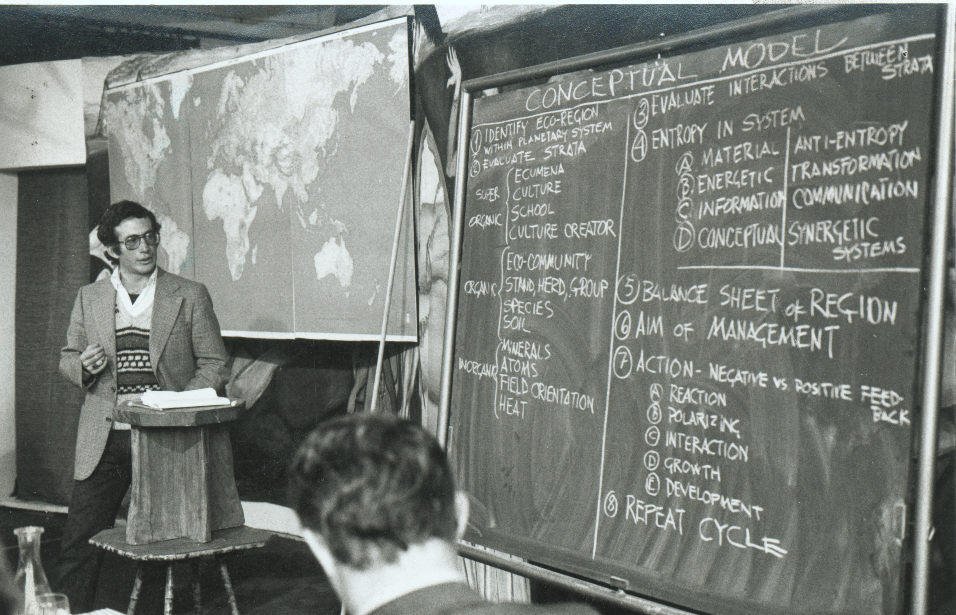
10:45 — History and Overview of the Technosphere
John P. Allen, FLS — Chairman, Global Ecotechnics Corporation, Santa Fe
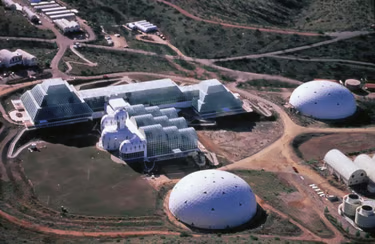
Inventor of Biosphere 2 and co-founder of the Institute of Ecotechnics, Allen examined the development of the technosphere and the challenge of harmonizing technology with ecology. His work in ecotechnics grew from decades of engineering, systems thinking, and demonstration projects around the world.
12:30 — Lunch
13:30 — Space Architecture and Architected Space
Constance Adams, AIAA — Space Architect, Synthesis International, Houston/New York
One of the world’s leading space architects, Adams was a key designer of NASA’s revolutionary TransHab inflatable space habitat. She explored how the extreme requirements of designing for space could also inspire new approaches to architecture on Earth.
15:00 — Break
15:15 — The Reinvention of the Moving Image
Gene Youngblood — Media Arts Department, College of Santa Fe
Internationally known as a theorist of media arts and politics, Youngblood was the author of the influential Expanded Cinema (1970), the first book to consider video as an art medium. His work helped establish the field of media arts and contributed to the emerging media democracy movement.
16:15 — Break
16:30 — Dialogue with the Machine #2
Woody Vasulka — Video Artist, Santa Fe
A pioneer of video and intermedia art, Vasulka co-founded The Kitchen in New York with Steina Vasulka in 1971. His experimental work investigated electronic imaging and the narrative and metaphorical possibilities created by new technologies.
19:00 — Dinner
20:00 — The Technics of War in the InfoAge
Jack Thorpe — Consultant, Defense Advanced Research Projects Agency (DARPA), San Diego
Considered the father of networked simulation, Thorpe pioneered the concept behind SIMNET in the 1980s. His work transformed military simulation and contributed to later developments in desktop simulators, interactive environments, and networked virtual spaces.
21:30 — Techno Lounge
Sunday, October 9
08:30 — Breakfast
09:00 — Decline and Fall of the Carbon Empire: The Coming Age of Nanobiotechnology (via uplink)
Alan Goldstein — Industrial Nanobiotechnology Consultant and Professor of Biotechnology Engineering, Alfred University
A pioneer in nanobiotechnology, Goldstein explored the convergence of biotechnology and nanotechnology, from biomaterials and medical devices to the possibility of technologies capable of profoundly altering healthcare and human evolution.
10:30 — Coffee/Tea Break
10:45 — The Technics of Virtual Space and Communities
Bruce Damer — CEO and Founder, Digital Space Commons, Santa Cruz
A leading theorist and practitioner of virtual reality and online communities, Damer worked with organizations ranging from NASA to Xerox, IBM, and Siemens-Nixdorf. His presentation examined the emerging architecture and social possibilities of virtual environments.
12:30 — Lunch
13:30 — Communications
Daniel Kranzler — Chairman and CEO, MFORMA Corporation, Seattle
A telecommunications pioneer and entrepreneur, Kranzler played an important role in the development of wireless communications, paging, cellular networks, telecommunications software, and mobile media. He examined the rapidly evolving technologies connecting people across the planet.
15:00 — Tea Break
15:15 — Cinetechnics: Aliens of the Deep
Andrew Wight — President, Great Wight/Earthship Productions, Malibu
An accomplished cave and open-water diver and underwater filmmaker, Wight produced documentaries in some of the world’s most challenging environments. Working with James Cameron’s documentary division, he helped develop techniques for filming the Bismarck and deep-ocean hydrothermal vents—environments offering clues to the origins and evolution of life.
16:30 — Group Photo — Speakers and Participants
19:00 — Dinner
20:00 — Technics for Winning the Oil End Game
Amory Lovins — Founder and President, Rocky Mountain Institute, Snowmass, Colorado
A leading advocate for energy efficiency and sustainable resource use, Lovins challenged conventional supply-side approaches to energy. His work demonstrated how technological innovation, efficiency, renewable energy, and market forces could help transform global energy systems.
21:30 — Techno Lounge
Monday, October 10
08:30 — Breakfast
09:00 — Technology and the Revolution in Science
Rick Satava — Program Manager, DARPA, and Department of Surgery, University of Washington, Seattle
At the forefront of telemedicine and advanced medical technologies, Satava explored emerging developments in robotic surgery, remote healthcare, biosensing, patient monitoring, and technologies capable of transforming both military and civilian medicine.
11:30 — Buffet & Conference Wrap-up
About the Conference
The 2005 conference examined the technosphere as an evolving planetary system, looking beyond technology simply as machinery to consider its increasingly complex relationship with culture, ecology, energy, communications, art, medicine, warfare, and human evolution. From Biosphere 2 and renewable energy to virtual worlds, nanobiotechnology, space architecture, and electronic art, the conference explored both the transformative possibilities and profound challenges of technological change.