About the Book
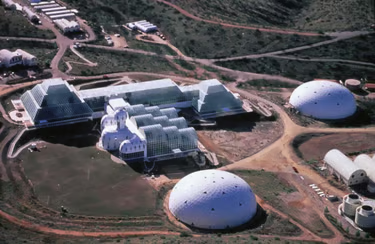
The Walls Came Tumbling Down: Biosphere 2 and the Soviet Space Program, by Dr. Mark Nelson, written in 2019, tells the remarkable, largely untold story of the scientific relationships forged between the pioneering Biosphere 2 project in Arizona and leading Soviet space research institutions during the final years of the Cold War.
At a time when the world was divided by political ideology, suspicion, and the Iron Curtain, an extraordinary group of scientists, engineers, ecologists, and visionaries discovered common ground in their pursuit of one of humanity’s greatest challenges: understanding how to sustain life within closed ecological systems, both on Earth and beyond.
Drawing on firsthand experience and fascinating behind-the-scenes accounts, Nelson reveals how Soviet advances in ecological life-support technologies intersected with the groundbreaking Biosphere 2 experiment. While Soviet researchers had spent decades developing systems to support humans during extended space missions, Biosphere 2 sought to understand the intricate relationships between atmosphere, water, soil, plants, animals, and people within a materially closed environment.
These exchanges brought together decades of scientific knowledge, technological innovation, and practical experimentation. Both endeavors addressed a fundamental question: How can complex living systems be understood, maintained, and sustained over time? The answers held implications not only for future human settlements in space but also for understanding and caring for Earth’s biosphere.
The book illuminates the human dimension of scientific discovery: the courage to pursue unconventional ideas, the determination to overcome institutional resistance, and the extraordinary challenges of turning ambitious concepts into working realities. It also places Biosphere 2 within a broader history of ecological science, revealing connections with Soviet research that helped shape the emerging discipline of biospherics.
Featuring perspectives from influential thinkers and scientists, including Sir Arthur C. Clarke, Academician Oleg Gazenko, Howard T. Odum, Jane Goodall, and Academician Josef Gitelson, Nelson’s account offers a compelling perspective on an extraordinary period of scientific ambition and discovery.
At its heart, The Walls Came Tumbling Down is a story of vision, ingenuity, and the power of science to cross boundaries. In today’s atmosphere of international distrust and nationalistic isolation, it offers a timely reminder that curiosity, imagination, and shared purpose can achieve what political divisions often make seem impossible.
“I consider Biosphere 2 one of the most hopeful things that has happened in the United States for quite a while.” – Sir Arthur C. Clarke, scientist, futurist, author.
“Events of historical significance do not happen every day… We’re witnessing the completion of the first very important and responsible mission inside Biosphere 2… We in Russia with great sympathy and tremendous interest have followed the advancement of this pioneering project. We believe results obtained in this experiment in combination with global studies of Earth biosphere through remote monitoring and extensive application of scientific technology will not only contribute to a better life on the Earth but will also serve the task of the human planetary exploration of the solar system.”
Academician Oleg Gazenko, Director of the Institute of BioMedical Problems, Russian Academy of Science, Moscow.
“The original management of Biosphere 2 was regarded by many scientists as untrained for lack of formal degrees, even though they had engaged in a preparatory study program for a decade, interacting with the international community of scientists including the Russians involved with closed systems. The history of science has many examples where people of atypical background open science in new directions [and with] fresh hypotheses.” — Professor Howard T. Odum, University of Florida.
“I truly believe that this great experiment, the vision of these people, the courage of the biospherians and the people who saw it through in spite of criticism, this will really lead to a tremendous increase in our understanding of environmental problems and that in turn will lead to new technologies to heal the world and make it a better place for our children and their children tomorrow.” — Dr. Jane Goodall, primatologist and anthropologist, world expert on chimpanzees.
“My only issue with this project is that it has the wrong name. It’s not Biosphere 2 but Noosphere 1, for in such a small world, intelligence will be needed to make it succeed.” –
Academician Josef Gitelson, Director, Institute of Biophysics, Krasnoyarsk, Siberia where the most advanced Soviet space life support research was conducted.